Copper Hair Formulas 2026: From Dark Copper to Ginger
Detailed copper hair formulas by brand (Wella, Schwarzkopf, L'Oréal) and starting level. Application techniques and corrections for professionals.
Blendsor
Blendsor Team
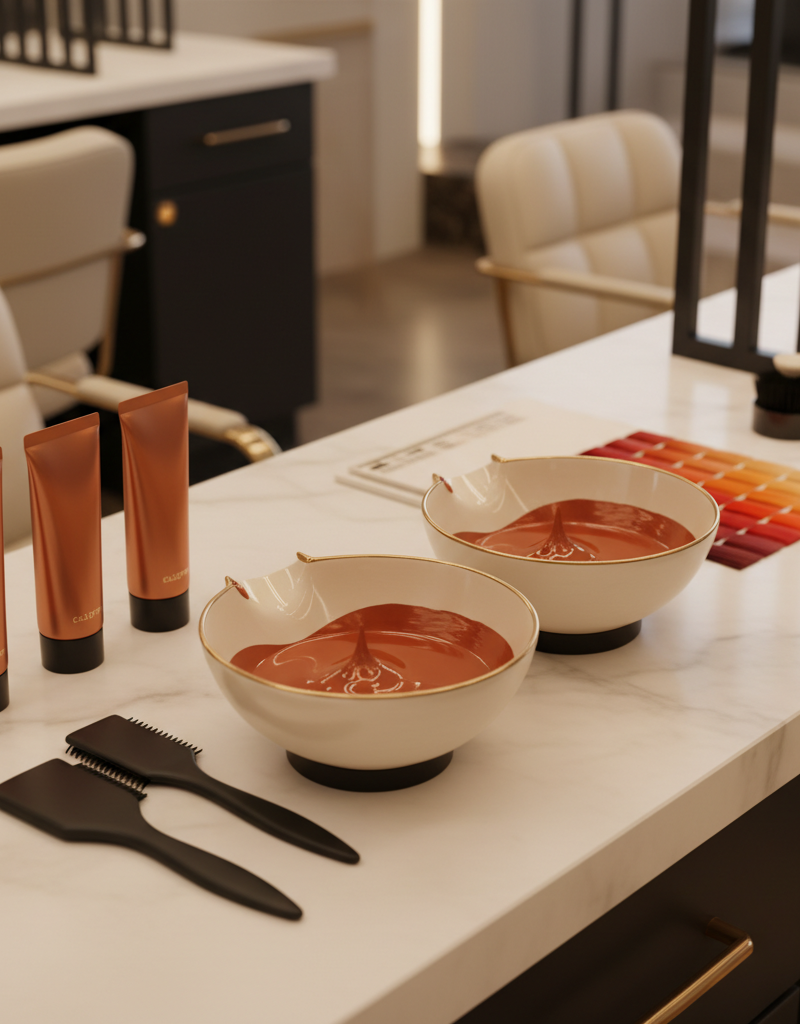
Your client shows you a copper hair photo from Instagram and you think: “great, but which brand and what reflect code gets me exactly that”?
If you work with copper hair color formulas regularly, you know the difference between editorial copper and carrot orange comes down to the formula. Not the intention, not the technique: the numbers you mix. We already covered what the Ginger Glow trend is and its variants, but now it is time for what truly matters in the salon: concrete formulas based on the brand you use and the starting level.
How copper pigments work in formulation
Professional copper formulas are built by combining reflects from the .4 family (copper), .3 (gold), and .44 (intense copper). Each brand codes these pigments slightly differently, but the logic is universal.
According to the Society of Cosmetic Chemists, copper pigments are medium-sized molecules that partially penetrate the cortex. This explains two things: their immediate visual intensity and their relatively fast fading compared to cool tones.
| Reflect | Common code | Result | When to use |
|---|---|---|---|
| Pure copper | .4 | Intense copper, can look flat | As a base in mixes, never alone |
| Copper gold | .43 | Luminous copper with shine | Ginger Glow, editorial coppers |
| Gold copper | .34 | Gold with copper sparkle | Subtle coppers, first approach |
| Intense copper | .44 | Maximum copper, saturated | Spicy Ginger, maximum impact |
| Natural | .0 | No reflect, controls saturation | Mix at 10-20% to prevent excess |
The golden rule: never use a .4 reflect as the sole formula. Always mix at least two reflects to achieve dimension and avoid the “uniform orange” effect. Understanding how these reflects interact with the underlying pigment at each level is what separates a predictable result from a surprise.
Copper formulas by professional brand
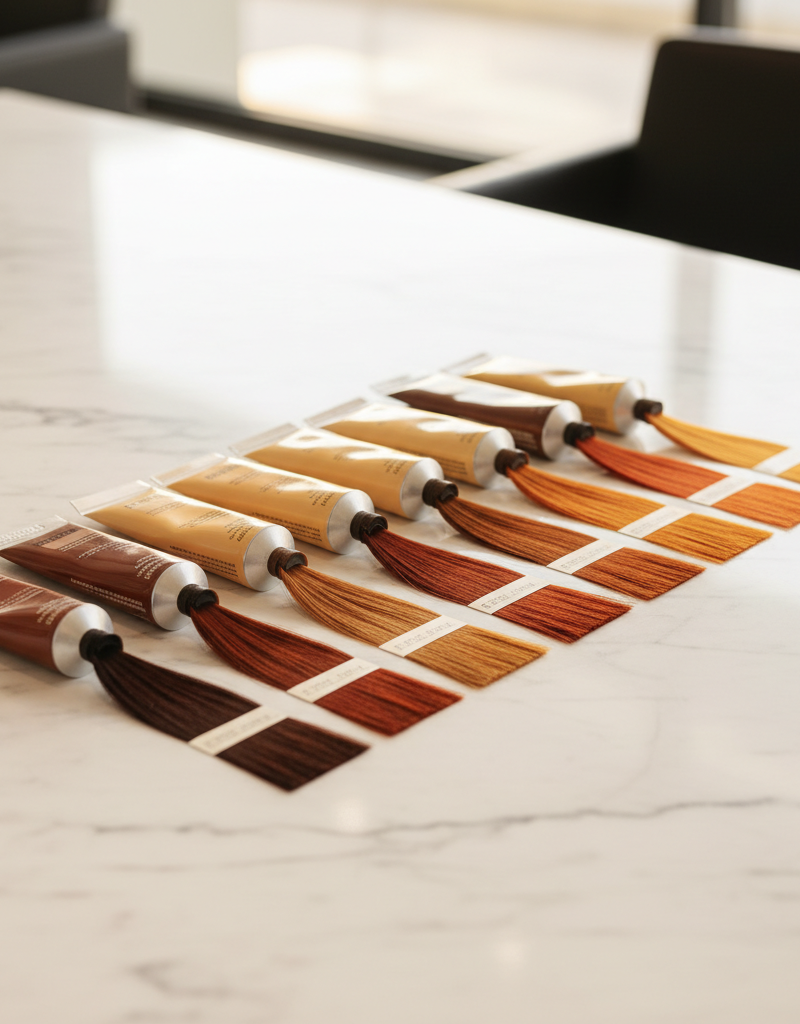
Each brand has its own chart and naming system. Here are proven formulas for the four most widely used professional brands.
Wella (Koleston Perfect / Color Touch)
Wella is the benchmark for coppers. Their /4 and /43 series have a pigment intensity that is hard to match.
| Goal | Koleston Perfect formula | Developer | Result |
|---|---|---|---|
| Spicy Ginger | 7/44 (50%) + 7/43 (30%) + 7/3 (20%) | Welloxon 6% (20 vol) | Vibrant editorial copper |
| Subtle Ginger | 7/34 (50%) + 7/3 (30%) + 7/0 (20%) | Welloxon 6% | Natural golden copper |
| Dark Ginger | 6/43 (40%) + 5/4 (30%) + 6/0 (30%) | Welloxon 6% | Deep sophisticated copper |
| Copper gloss | Color Touch 7/43 (70%) + 7/3 (30%) | Emulsion 1.9% (6 vol) | Maintenance between visits |
Pro tip: The Color Touch line is perfect for maintenance services between appointments. A hair gloss with Color Touch 7/43 every 4-6 weeks maintains vibrancy without building up pigment.
Schwarzkopf (Igora Royal / Vibrance)
Igora Royal offers coppers with excellent gray coverage, ideal when copper needs to cover gray hair simultaneously.
| Goal | Igora Royal formula | Developer | Result |
|---|---|---|---|
| Spicy Ginger | 7-77 (40%) + 7-57 (40%) + 7-5 (20%) | 6% (20 vol) | Intense copper with depth |
| Subtle Ginger | 7-57 (50%) + 7-5 (30%) + 7-0 (20%) | 6% | Natural golden copper |
| Dark Ginger | 6-77 (40%) + 5-7 (30%) + 6-0 (30%) | 6% | Dark dimensional copper |
| Copper + gray | 7-77 (40%) + 7-0 (40%) + 7-57 (20%) | 6% | Full coverage with copper reflect |
L’Oréal Professionnel (Majirel / Dia Light)
Majirel’s .4 series produces coppers with good longevity. Dia Light works as an ammonia-free alternative for maintenance.
| Goal | Majirel formula | Developer | Result |
|---|---|---|---|
| Spicy Ginger | 7.44 (50%) + 7.43 (30%) + 7.3 (20%) | ODS 6% (20 vol) | Vibrant and long-lasting copper |
| Subtle Ginger | 7.34 (50%) + 7.3 (30%) + 7.0 (20%) | ODS 6% | Soft luminous copper |
| Dark Ginger | 6.45 (40%) + 5.4 (30%) + 6.0 (30%) | ODS 6% | Deep copper-mahogany |
| Maintenance gloss | Dia Light 7.43 (70%) + 7.3 (30%) | Dia Activateur 7.5 vol | Refresh without buildup |
Alfaparf Milano (Evolution / Color Wear)
Very popular in Latin America and Europe. Their coppers have a slightly warmer undertone.
| Goal | Evolution of the Color formula | Developer | Result |
|---|---|---|---|
| Spicy Ginger | 7.44 (50%) + 7.43 (30%) + 7.3 (20%) | OXI Plus 20 vol | Warm intense copper |
| Subtle Ginger | 7.34 (60%) + 7.0 (40%) | OXI Plus 20 vol | Discreet golden copper |
| Dark Ginger | 6.43 (50%) + 5.4 (30%) + 6.0 (20%) | OXI Plus 20 vol | Toasted copper |
Formulas by starting level
The natural level completely changes the strategy. What works at level 7 is a disaster at level 4. Selecting the correct developer volume for each situation is fundamental.
| Starting level | Strategy | Developer | Sessions | Key note |
|---|---|---|---|---|
| 8-9 (blonde) | Direct deposit | 10-20 vol | 1 | Immediate result. Careful: can be too intense. Dilute with 20-30% natural |
| 7 (dark blonde) | Direct formula | 20 vol | 1 | Ideal level. The orange-yellow underlying pigment enhances copper |
| 5-6 (medium brown) | Activate underlying pigment | 20-30 vol | 1-2 | Add 10-20% natural. Second session for maximum vibrancy |
| 3-4 (dark brown) | Pre-lightening | 30-40 vol (bleach) + 20 vol (color) | 2 | Controlled bleaching first to level 6-7, then apply formula |
| 1-2 (black) | Progressive work | Multi-session | 3+ | Do not force. Dark Ginger at most in first session |
Pro tip: On very light blondes (level 9-10), copper can look “washed out” or too transparent. Always add 20-30% natural base (.0) to give body to the color and prevent it from disappearing after the second wash.
Application techniques for each result
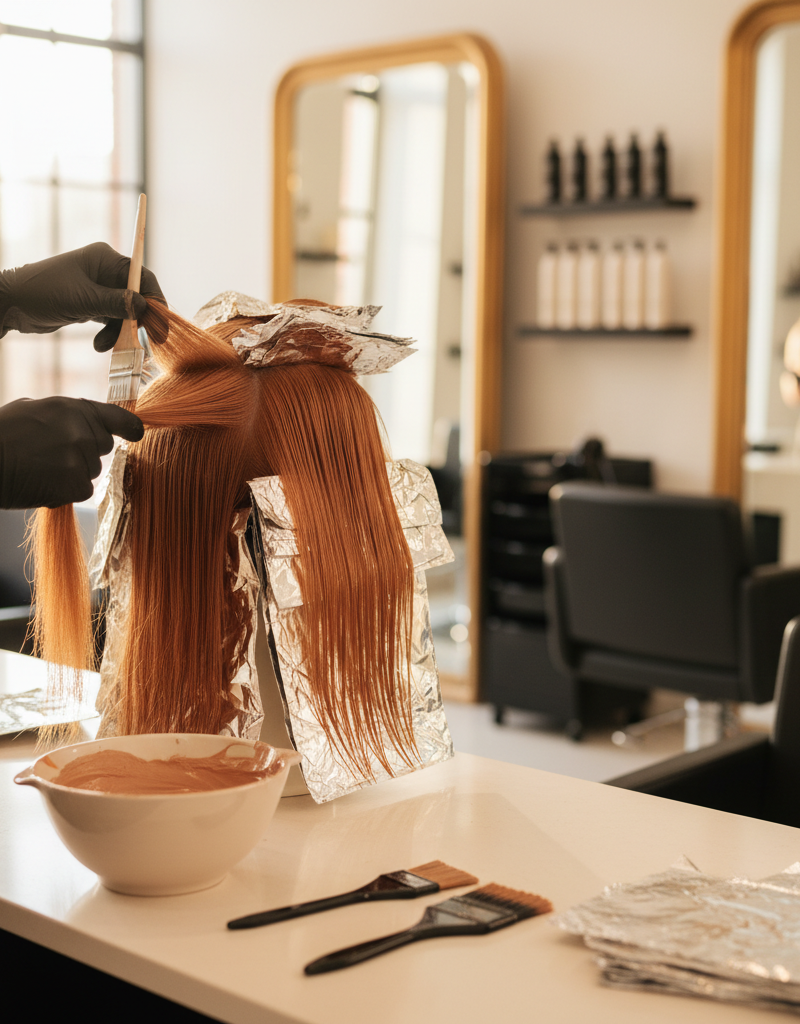
Not all coppers are applied the same way. The technique changes the final result as much as the formula.
Global (root to tip)
For a complete, uniform color change. Apply the formula from mid-lengths to ends first (more porous hair absorbs faster), then roots. Total time: 35-45 minutes depending on the hair’s porosity and condition.
Copper balayage
Balayage adds natural dimension to copper. Apply the ginger formula with freehand sweeping on mid-lengths and ends, keeping the root natural or with Dark Ginger. The root-to-tip contrast creates a spectacular depth effect. Review the differences with traditional highlights in our guide on balayage vs highlights.
Maintenance gloss
Every 4-6 weeks, a gloss with demi-permanent formula (Color Touch, Dia Light, Vibrance) refreshes the copper without building up pigment or compromising hair integrity. This is the perfect recurring service for copper clients.
How to correct a copper that went wrong
Coppers generate more corrections than any other color family. Here are the three most common problems and how to fix them.
Came out carrot orange instead of ginger: The mistake was using a .4 reflect alone without mixing. The correction: apply a gloss with .3 reflect (gold) + a touch of .1 (ash) at 10% to neutralize the orange without losing warmth. Formula type: demi-permanent 7.3 (60%) + 7.1 (10%) + 7.43 (30%).
Turned out too red / burgundy: The underlying pigment was too dark (level 4-5) and added red to the copper. The solution: neutralize with a green reflect (.2) at 10-15% in the next application, or do a color bath with gold tonality (.3) to push the tone toward copper and away from red.
Faded within a week: The developer was too strong for the need. If you only needed to deposit color (starting level already close to the target), 10-20 vol was sufficient. Higher developer volume means greater cuticle opening and less pigment retention. Next time: lower the volume and increase processing time. See our complete guide to professional color correction for more complex cases.
Frequently asked questions
Can I mix coppers from different brands?
Not recommended. Each brand formulates its pigments with different molecules, and the interaction between brands is unpredictable. If your salon works with multiple brands, choose one for each complete service.
What dye-to-developer ratio should I use for coppers?
The standard ratio is 1:1 (equal amounts of color and developer). For coppers this does not change. What varies is the developer volume based on the goal: 10-20 vol to deposit, 20-30 vol to lighten and deposit simultaneously.
Does copper cover gray hair?
Yes, but you need to adjust the formula. Add 30-40% natural base (.0) to the mix to ensure coverage on white hair. Without natural base, the copper pigment alone does not have enough opacity to cover gray durably.
How often does copper need retouching?
It depends on the variant and maintenance routine. With a care protocol (sulfate-free shampoo + weekly pigmented mask), a full retouch is needed every 6-8 weeks. Without specific care, visible intensity loss appears within 2-3 weeks.
Does copper work as balayage?
It is one of the best possible combinations. Copper balayage creates a “light trapped in the hair” effect that enhances the natural dimension of ginger. Plus, grow-out is less noticeable than with a global application.
In summary
- The formula defines the result: always mix .43 or .34 with .3 for luminosity, never .4 alone
- Each brand has its own code: the tables in this article give you proven formulas for Wella, Schwarzkopf, L’Oréal, and Alfaparf
- Starting level matters most: levels 7-8 are ideal, dark hair needs pre-lightening
- The right developer prevents premature fading: lowest possible volume for the goal
- Common corrections (orange, red, fading) have predictable solutions
Calculate copper formulas with AI
Want to generate the exact copper formula for the brand you use in your salon and each client’s starting level?
Try Blendsor free - 5 formulas per month, no credit card required.
Related articles

Apply this theory with precision
Blendsor analyzes 70+ variables and generates exact formulas based on real colorimetry. Try our free color consultation or download the app.
Download free