Hair Colorimetry Basics: Guide for Colorists
Master the fundamentals of hair colorimetry: color theory, levels, underlying pigments, and neutralization. The scientific foundation for precise formulation.
Blendsor
Blendsor Team
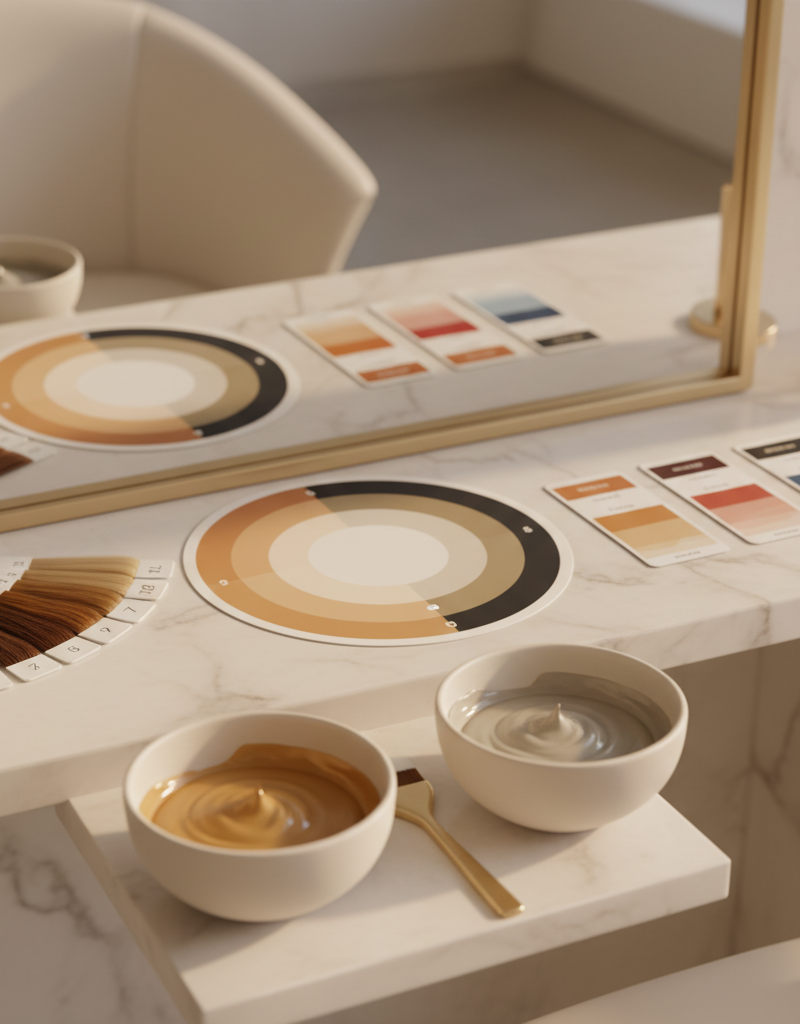
In short: Hair colorimetry studies how color interacts with hair through three pillars: color theory (color wheel and neutralization), the level system 1-10 with predictable underlying pigments, and reflects (.1 ash, .3 gold, .4 copper). Mastering these fundamentals enables precise scientific formulation and predictable results.
Why do some formulas work perfectly while others turn into disasters? The answer lies in colorimetry.
If you’ve been in the salon for a while, you know that formulating color isn’t just about mixing numbers. Behind every result is a precise science that, when you understand it, transforms the way you work. The ashy blonde that turns out perfect. Gray coverage without surprises. Balayage with flawless transitions.
In this guide, we’ll build the foundations of hair colorimetry together. From color theory to its practical application in the salon. Everything you need to formulate with confidence.
What is Hair Colorimetry
Hair colorimetry is the science that studies how color interacts with human hair. It enables predicting results, formulating precisely, and correcting errors by applying principles of physics, chemistry, and visual perception. It rests on three fundamental pillars:
- Color theory: The color wheel and complementary colors (orange-blue, yellow-violet, red-green) that enable neutralizing unwanted tones.
- Level system: Scale from 1 (black) to 10 (platinum blonde) with predictable underlying pigments at each level.
- Reflects and chemistry: The numbers after the decimal (.1 ash, .3 gold, .4 copper) define the hue, while developers (10-40 vol) control lift and damage.
The difference between a colorist who “tries to see what happens” and one who formulates with confidence is right here. In mastering these fundamentals.
Let’s dive deeper into each pillar.
Color Theory: The Color Wheel
The color wheel is your map for understanding how colors relate to each other. Based on the Munsell color notation system, which organizes colors by hue, value, and chroma, this tool is fundamental for any colorist. Although it may seem like abstract theory, you use it every day when neutralizing orange or balancing violet.
Primary Colors
The three colors that cannot be created by mixing others:
- Blue: The coolest, present in ash tones
- Red: The warmest, appears in dark underlying pigments
- Yellow: Luminous, appears in light underlying pigments
Secondary Colors
Formed by mixing two primaries:
- Orange = Red + Yellow
- Green = Blue + Yellow
- Violet = Blue + Red
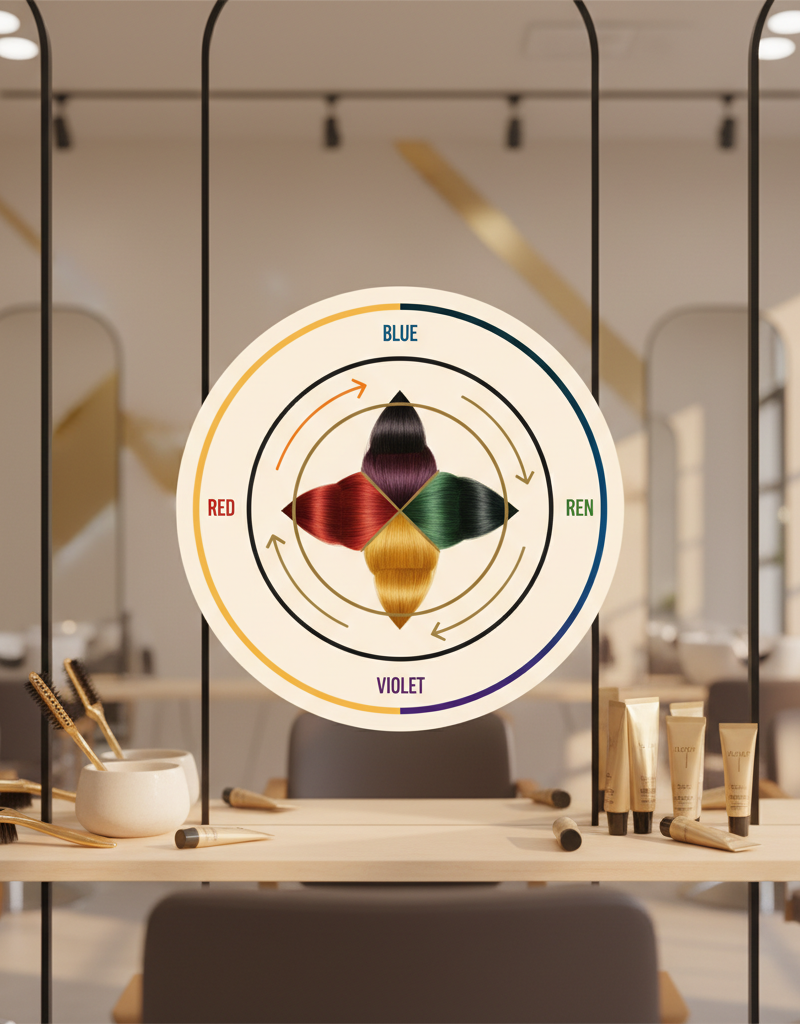
Complementary Colors
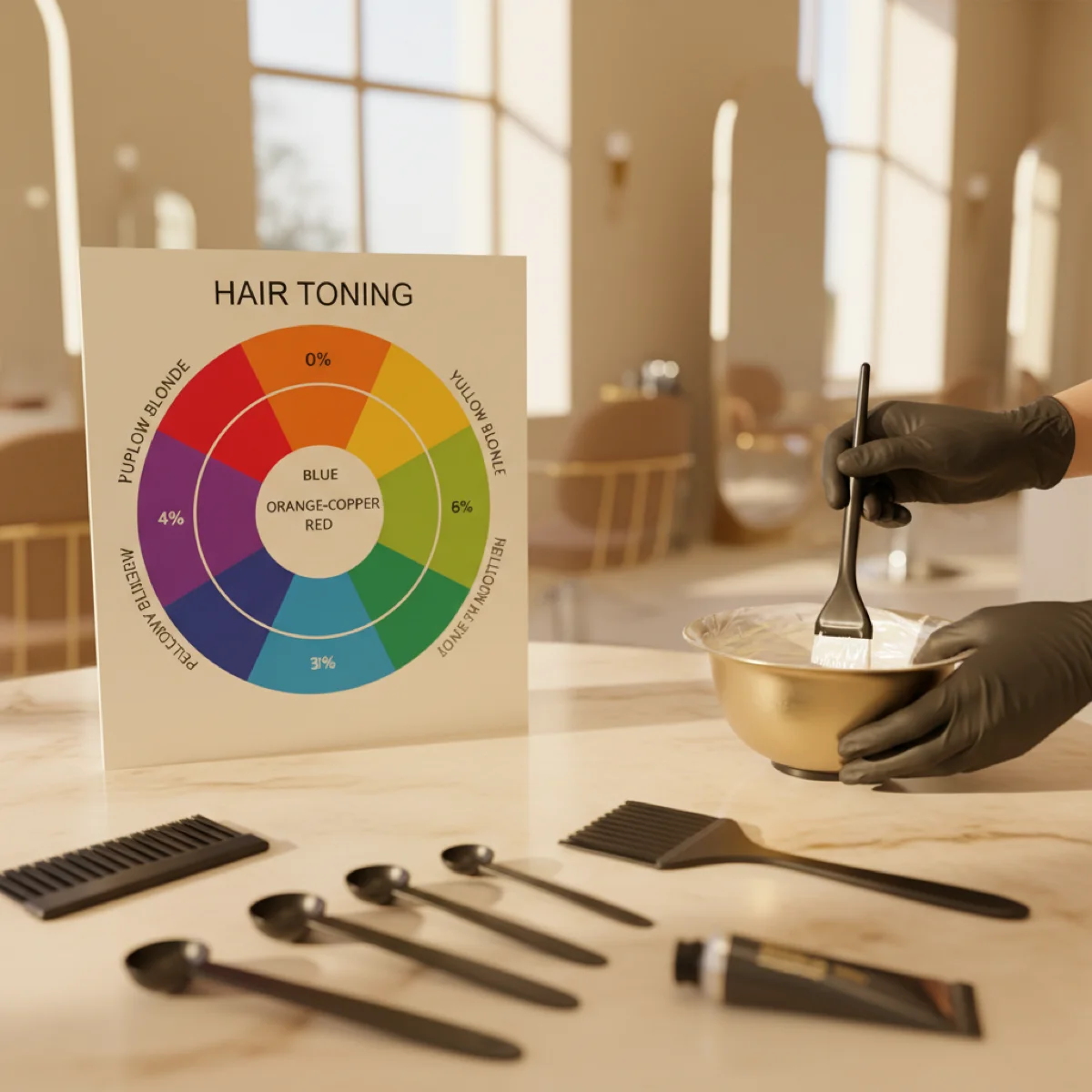
Here’s the key to neutralization. Opposite colors on the wheel cancel each other out:
According to the Munsell color notation system, colors that sit diametrically opposite in chromatic space neutralize each other. In hair colorimetry, this translates to:
| Color | Complementary | Practical Use |
|---|---|---|
| Orange | Blue | Neutralize warm bleached hair |
| Yellow | Violet | Tone brassy blondes |
| Red | Green | Cancel red bases |
| Green | Red | Correct green tones |
When you mix a color with its complementary in equal amounts, you get a neutral tone (brown or gray, depending on the level).
Pro tip: Never use pure complementaries at 100%. Always dilute them with a natural tone to avoid muddy results.
The Level System: 1 to 10
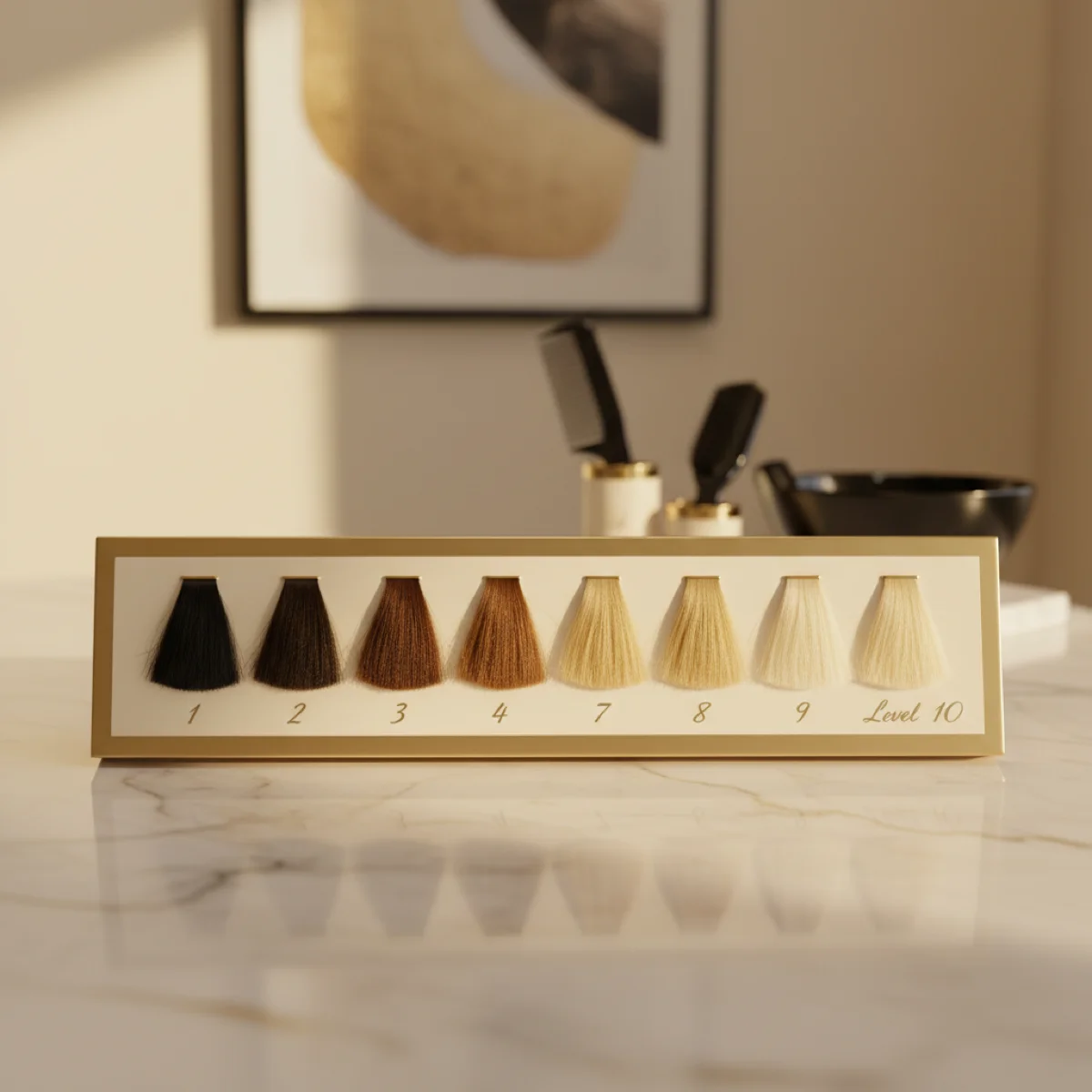
The tone level indicates how light or dark a color is. It’s a universal system that goes from 1 (black) to 10 (platinum blonde).
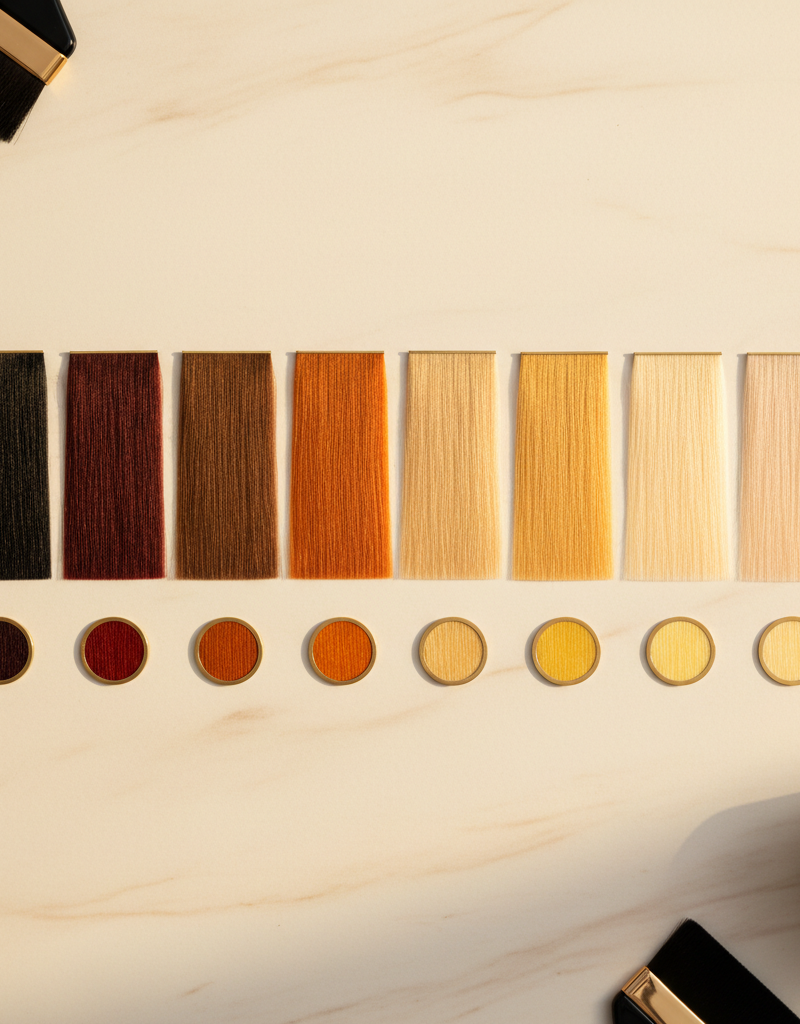
Level Chart with Underlying Pigments
Each level has an associated underlying pigment. This is the pigment that appears when you lighten hair:
| Level | Description | Underlying Pigment |
|---|---|---|
| 1 | Black | Dark red |
| 2 | Very dark brown | Red |
| 3 | Dark brown | Red-orange |
| 4 | Medium brown | Orange-red |
| 5 | Light brown | Orange |
| 6 | Dark blonde | Yellow-orange |
| 7 | Medium blonde | Orange-yellow |
| 8 | Light blonde | Yellow |
| 9 | Very light blonde | Pale yellow |
| 10 | Extra light blonde | Very pale yellow |
According to the Society of Cosmetic Chemists, melanin oxidation follows a predictable sequence: eumelanin (dark pigment) degrades first, progressively revealing the underlying pheomelanin (warm pigment). This knowledge is fundamental. If you lighten a level 4 and orange-red appears, it’s not a mistake: it’s chemistry. And knowing this, you can neutralize it correctly.
To dive deeper into how to correctly identify levels, check out our complete guide to hair color levels.
How to Identify Natural Level
Misdiagnosing the level is one of the most common mistakes. Here’s the correct process:
- Proper lighting: Natural or neutral white light. Never warm salon light
- Correct zone: The nape, less affected by sun
- Dry hair: Wet hair appears darker
- Compare with swatches: Don’t rely on your eye alone
- Consider gray hair: Can “raise” the perceived level
The 4-Level Rule
Oxidative dye can lighten a maximum of 4 levels on natural hair.
Examples:
- Level 3 → maximum level 7
- Level 5 → maximum level 9
- Level 6 → maximum level 10
To lighten more, you need pre-lightening.
The Reflect System: Understanding Color Codes
After the level comes the reflect. That number after the decimal point that defines the color’s hue.
Universal Reflect Numbering
Although it varies slightly between brands (you can compare exact nomenclature in our hair color converter), the general system is:
| Number | Reflect | Characteristics |
|---|---|---|
| .0 | Natural | Base without dominant reflect |
| .1 | Ash | Blue/violet, cool |
| .2 | Iridescent/Violet | Pure violet |
| .3 | Gold | Warm yellow |
| .4 | Copper | Orange/copper |
| .5 | Mahogany | Red-violet |
| .6 | Red | Pure red |
| .7 | Matte/Green | Matte base, anti-red |
How to Read Color Codes
In a code like 7.13:
- 7 = Level (medium blonde)
- 1 = Primary reflect (ash)
- 3 = Secondary reflect (gold)
Result: Medium blonde ash with golden undertone (a warm ash, less cold than a pure 7.1).
Reflect Mixing Rules
- Cool reflects (.1, .2) neutralize warm tones
- Warm reflects (.3, .4, .5, .6) add luminosity
- Natural base (.0) softens and adds body to the color
- Never mix more than 3 reflects: The result will be muddy
Predict the exact result of mixing two shades with our hair color mixing calculator.
Developers: The Other Half of the Equation
Developer isn’t just “the liquid you mix with the dye.” It’s an active component that determines the final result. According to research from the Society of Cosmetic Chemists, hydrogen peroxide concentration directly affects both lift and damage to the hair fiber.
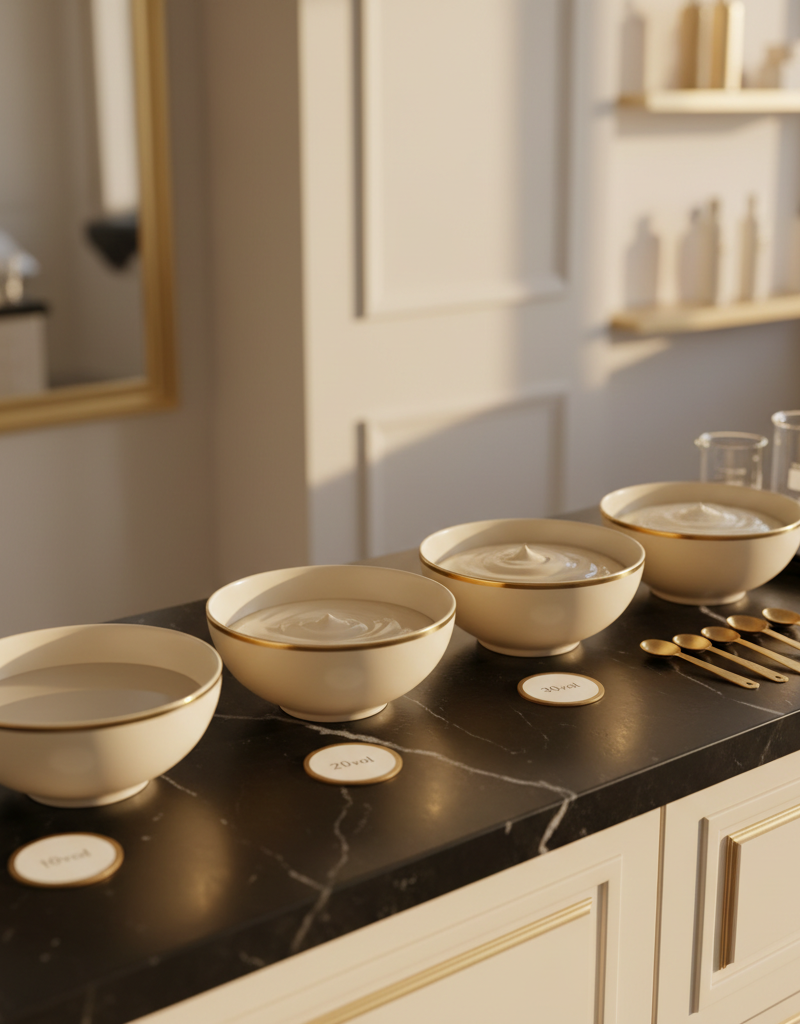
Volumes and Lifting Power
| Volume | Concentration | Lift | Main Use |
|---|---|---|---|
| 10 vol | 3% | 0-1 level | Deposit, toning |
| 20 vol | 6% | 1-2 levels | Standard, gray coverage |
| 30 vol | 9% | 2-3 levels | Highlights, dark bases |
| 40 vol | 12% | 3-4 levels | Bleaching (with caution) |
According to research from the Society of Cosmetic Chemists, each 10-volume increment doubles the hydrogen peroxide concentration and proportionally increases damage to the hair fiber. The golden rule: use the minimum volume necessary for the result. More developer doesn’t mean better results, it means more damage.
To understand when to use each volume, check out our guide to developer volumes.
Dye to Developer Ratios
| Technique | Ratio | Notes |
|---|---|---|
| Global color | 1:1 | Standard |
| High-lift tints | 1:2 | More power |
| Semi-permanent | 1:1 or 1:1.5 | Brand dependent |
| Color bath | 1:2 or 1:3 | Dilution |
Neutralization: The Art of Correcting
Mastering neutralization is what separates a good colorist from an excellent one. It’s the practical application of everything above.
Basic Principle
Complementary colors cancel each other out. But the key is in proportions:
- Slight unwanted tone: 1/4 corrector
- Medium unwanted tone: 1/3 corrector
- Intense unwanted tone: 1/2 corrector
Practical Cases
Neutralizing orange (levels 5-6):
- Use ash reflects (.1)
- Formula type: 7.1 (30g) + 7.01 (20g) + 7 natural (10g)
- The natural touch prevents it from looking “muddy”
To see these principles applied to specific cases, check our professional color formulas with developer, timing, and neutralization step by step.
Neutralizing yellow (levels 8-9):
- Use violet reflects (.2)
- Specific toners
- Short time: 5-15 minutes maximum
Neutralizing red (levels 2-4):
- Never use pure green
- Use ash with matte base (.13 or .31)
- Requires more time and patience
For specific neutralization techniques, check out our guide to neutralizing unwanted tones.
Professional Diagnosis: Before Formulating
Before mixing anything, you need information. A complete diagnosis includes:
1. Hair History
Key questions:
- When was the last dye applied?
- What brand and color did they use?
- Have you ever used henna?
- Have you had highlights or bleaching?
2. Current Condition
- Natural level: At the root zone
- Level in mids and ends: May differ from previous treatments
- Porosity: High absorbs quickly, low needs more time
- Elasticity: Indicates fiber health
- Gray percentage: Affects formulation
3. Desired Result
- Show visual examples
- Agree on realistic expectations
- Document in writing
The most common diagnosis mistakes are in our guide on color formulation errors.
Step-by-Step Formulation
With the complete diagnosis, formulation follows a logical process:
Step 1: Determine Target Level
What level does the client want to reach? Is it achievable with dye or does it need bleaching?
Step 2: Calculate Level Difference
Target level - Current level = Levels of difference
This determines the necessary developer.
Step 3: Consider the Underlying Pigment
What pigment will appear when lightening? Do you need to neutralize it?
Step 4: Choose Reflects
- Primary reflect: The dominant one
- Secondary reflect: Modifies or balances
- Natural base: Softens if necessary
Step 5: Calculate Proportions
Adjust quantities based on:
- Intensity of neutralization needed
- Hair length
- Hair density
Practical Example
Client: Natural level 5, wants cool medium blonde (7.1)
- Difference: 7 - 5 = 2 levels → 20 vol developer
- Underlying pigment levels 5-7: Orange → Needs ash
- Formula: 7.1 (40g) + 7.01 (15g) + 7 (5g) + 20 vol developer (60ml)
- Time: 35-40 minutes
- Expected result: Medium ash blonde without orange streaks
Common Mistakes and How to Avoid Them
1. Diagnosing by Eye
Problem: The perceived level isn’t the real one. Solution: Always use swatches and correct lighting.
2. Ignoring History
Problem: Unpredictable reactions with previous chemicals. Solution: Detailed file for each client.
3. Excess Corrector
Problem: Muddy or dull tones. Solution: Start with less, add if needed.
4. Not Doing Strand Tests
Problem: Unpleasant surprises at scale. Solution: Always test in doubtful cases.
5. Mixing Brands
Problem: Each system is internally calibrated. Solution: Use dye and developer from the same line.
Quick Formulation Guide by Scenario
This table covers the most common salon scenarios and provides a formulation starting point:
| Common Scenario | Starting Level | Target Level | Formula Type | Developer | Key Insight |
|---|---|---|---|---|---|
| Darkening 2 levels | 7 | 5 | 5.0 (60%) + 5.1 (40%) | 10 vol | Underlying pigment doesn’t interfere when going darker; 10 vol deposits without damage |
| Lifting 2 levels | 5 | 7 | 7.0 (40%) + 7.1 (30%) + 7.03 (30%) | 20 vol | Orange undertone at level 5-6 requires ash (.1) to neutralize |
| Gray coverage (>50%) | 6 (with grays) | 6 | 6.0 (70%) + 6.1 (30%) | 20 vol | Gray hair is resistant; use 20 vol and minimum 70% natural base |
| Correcting orange | 6 (orange) | 7 ash | 7.1 (50%) + 7.01 (30%) + 7.0 (20%) | 20 vol | The .01 adds coolness without muddiness; .0 provides balance |
Frequently Asked Questions
How many levels can dye lift?
Oxidative dye lifts a maximum of 4 levels on natural hair. For more lift, pre-lightening is required. This limit exists because dye deposits pigment while lightening, which limits its lifting power.
Why does orange appear when bleaching?
Orange is the underlying pigment of levels 5-6. It appears because when you remove melanin, the underlying pigments (pheomelanin) become visible. According to the International Association of Trichologists, this is a normal chemical process of hair, not a mistake. It’s neutralized with blue/ash.
What’s the difference between .1 and .01 in color codes?
The .1 indicates a pure, dominant ash. The .01 indicates a natural base with a soft ash undertone. The first is more powerful for neutralizing, the second is more natural and less cold.
Can I mix developers of different volumes?
Yes, to get intermediate volumes. The mix is proportional: 20 vol + 30 vol in equal parts = ~25 vol. But always from the same brand.
How long should I leave the dye on?
It depends on the goal: 30-35 minutes for standard color, 45 minutes for gray coverage. Never longer than the time indicated by the manufacturer. Extra time doesn’t improve the result, it only damages.
In Summary
Hair colorimetry is built on these pillars:
- Color theory: Complementaries neutralize, primaries don’t mix to form pure colors
- Level system: From 1 to 10, each level has its predictable underlying pigment
- Reflects: The language of numbers after the decimal defines the final hue
- Developers: The minimum necessary for the result, not the maximum available
- Diagnosis: Without precise information, there’s no correct formulation
Mastering these fundamentals isn’t optional. It’s what allows you to go from “let’s see what happens” to “this is exactly what’s going to happen.”
Want formulas calculated with scientific precision? Try Blendsor free. The AI analyzes your client’s hair and suggests formulations based on real colorimetry.
This article is the starting point of our colorimetry cluster. Explore the related articles to dive deeper into each specific topic.
Articles in this guide
- Hair Color Levels: From 1 to 10
- Cool Blonde Without Orange: Pro Guide
- Hair Color Developer: Choosing Volumes
- 7 Color Formulation Mistakes to Avoid
- Color Correction: How to Fix Failed Hair Dye
- Gray Hair Coverage: Complete Professional Guide
- The 5 Grey Hair Coverage Levels Explained
- How to neutralize unwanted tones in hair
- Redken to Schwarzkopf: Shades EQ to Igora Vibrance Conversion Guide
- How to Switch Professional Hair Color Brands Without Losing Results
Related articles
Practice with our free tools
Calculators, neutralization wheel, AI consultation...
Apply this theory with precision
Blendsor analyzes 70+ variables and generates exact formulas based on real colorimetry. Try our free color consultation or download the app.
Download free