How to neutralize unwanted tones in hair
Master color theory to correct unwanted orange, yellow, and red tones in hair. Practical guide with professional formulas and real salon examples.
Blendsor
Blendsor Team
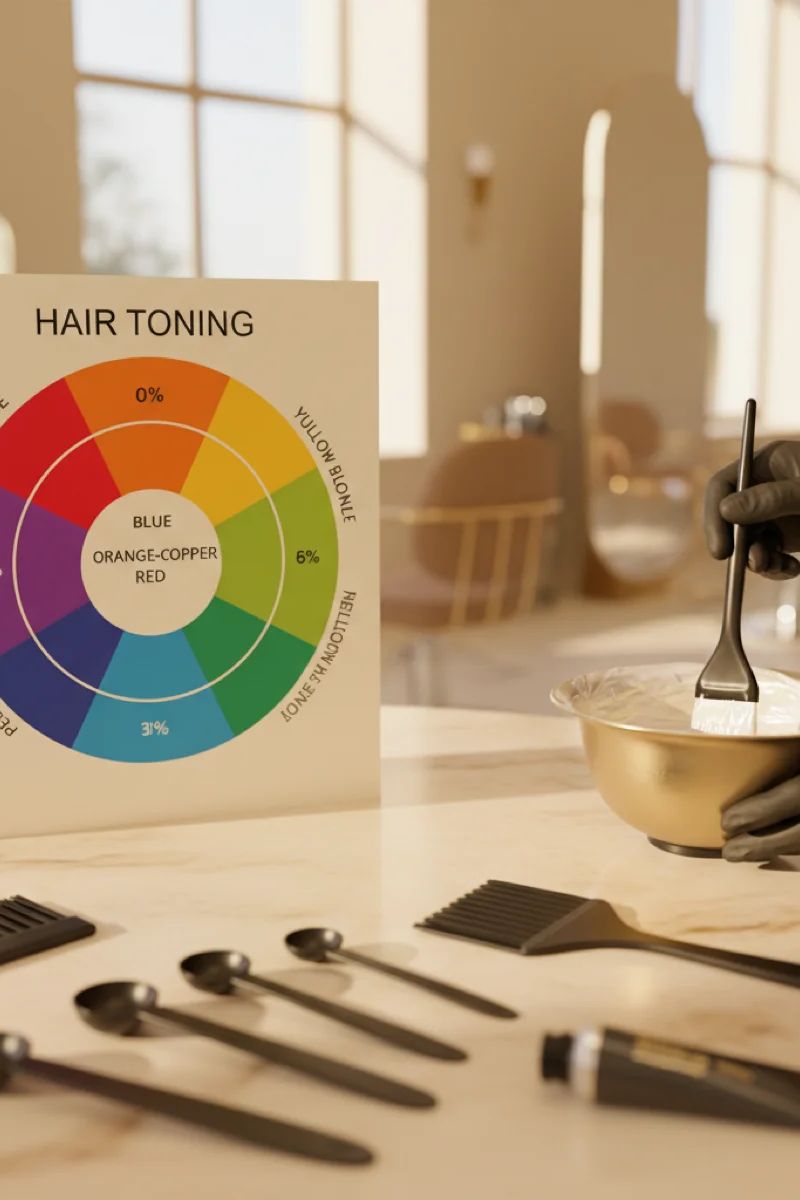
To neutralize unwanted hair tones, use complementary colors: blue cancels orange, violet cancels yellow, and green cancels red. The key is matching the intensity of your corrector to the intensity of the unwanted tone—too little won’t work, too much creates muddy results.
The brassy orange after a bleach. The straw yellow that won’t go away. The red peeking through where it shouldn’t. Every colorist has faced these color ghosts. For the complete science behind why this works, see our guide to hair colorimetry basics.
Quick summary: Neutralizing unwanted hair tones relies on complementary colors: blue cancels orange, violet cancels yellow, green cancels red. The corrector proportion ranges from 1/4 (light tone) to 1/2 (intense tone), always at the same level or one level higher than the target result.
How does the color wheel work for neutralizing hair tones?
Neutralization works by applying the opposite color on the color wheel: blue cancels orange, violet cancels yellow, green cancels red. In equal proportions, complementary colors produce a neutral tone. The Munsell color system provides the scientific framework for understanding these complementary hue relationships and why opposite colors cancel each other out. See the complete color relationships with our interactive neutralization wheel.
| Unwanted tone | Neutralizing color |
|---|---|
| Orange | Blue |
| Yellow | Violet |
| Red | Green |
| Green | Red |
A note on numbering before you go on: the reflect digits used in this article (
.1,.2,.7…) follow L’Oréal notation. The colour family is universal — blue against orange, violet against yellow, green against red — but the number naming it changes from house to house: matte (green) is,7at L’Oréal and/2at Wella. Always translate to your own shade chart before you weigh anything.
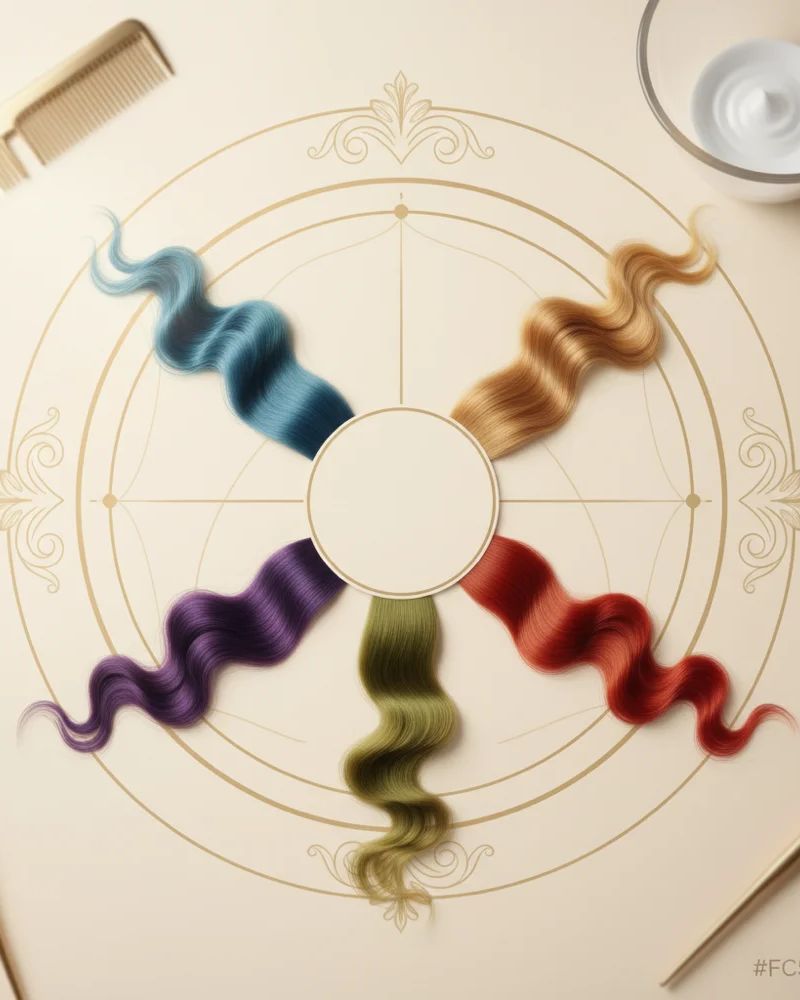
When you mix a color with its opposite in equal proportions, you get a neutral tone (brown or gray, depending on the level).
How do you neutralize orange in hair?
Orange hair is neutralized with blue: ash tones (.1 reflect) for intense orange at levels 5-6, or ash-violet (.01 reflect) for yellow-orange at level 7. A sample formula for level 6 orange is 7.1 (30g) + 7.01 (20g) + 7 (10g) with 10 vol developer. Always add a natural base to prevent muddy results.
Orange typically appears in:
- Bleaching that hasn’t reached the desired level (check our color levels guide to understand why)
- Dark dyed hair being lightened
- Exposed level 5-6 hair
To find the exact toner that neutralizes each type of orange, use our toner selector — input the level and unwanted tone. For a deeper dive into why blue (not violet) is the key, read our blue toner for orange hair guide. To calculate the exact proportions for mixing your neutralizing formula, try the color mix predictor.
Practical solution
-
Identify the orange intensity
- Intense orange → Pure blue (.1 or ash)
- Yellow-orange → Blue-violet (.01 or ash-pearl)
-
Sample formula for level 6 orange
- 7.1 (30g) + 7.01 (20g) + 7 (10g)
- 10 vol. developer (1:1.5)
The touch of natural base (.0) prevents the result from looking too “muddy” or dull.
How do you neutralize yellow in blonde hair?
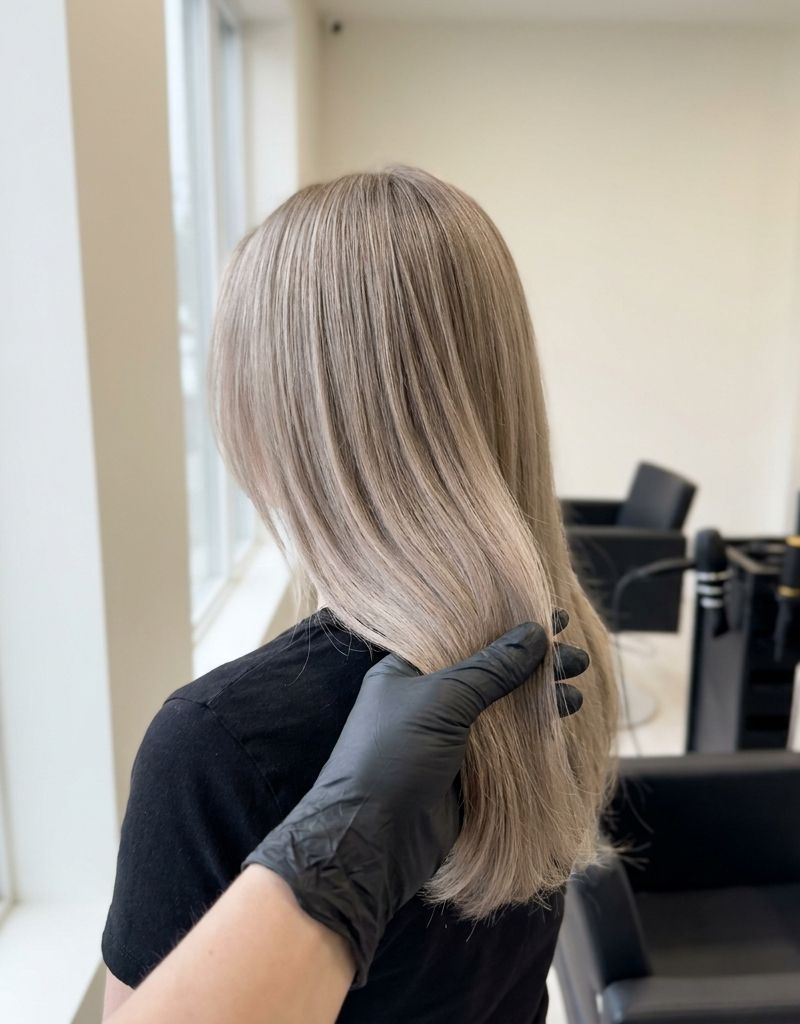
Yellow in blonde hair is neutralized with violet: .2 reflect (pearl/violet) with 6-10 vol developer for 10-15 minutes maximum. Over-application shifts the result gray or pink. For a professional toning, use 9.21 (40g) + 10.01 (20g) at 1:2 with developer. Less time always gives more control at levels 8-9.
Straw yellow is enemy number one for cool blondes. It appears in:
- Natural blondes with warm undertones
- Bleaching that reaches level 8-9
- Highlights that oxidize in the sun
When the goal is an intentional silver result — not just removing yellow — see our quiet silver formula guide for precise violet-neutralization formulas.
Practical solution
-
Violet is your friend
- .2 reflect (pearl/violet)
- Pure violet toners
-
Sample formula for toning yellow blonde
- 9.21 (40g) + 10.01 (20g)
- 6-10 vol. developer (1:2)
- Time: 10-15 minutes maximum
- If using a demi like Shades EQ or Igora Vibrance, check toner equivalences between brands to find the exact shade in your line
Caution: Excess violet creates gray or even pink tones. Less is more.
How do you neutralize red tones in hair?
Red tones are neutralized with green, and on a shade chart that green is the matte family: ,7 at L’Oréal, /2 at Wella. Watch out for a widespread numbering mistake: a ,13 is not a matte — it is ash + gold (blue + yellow), which is precisely what L’Oréal sells as beige. It does nothing against red.
Unwanted red usually comes from:
- Previous dyes with red bases
- Oxidized henna
- Underlying pigment at levels 1-4
Practical solution
Green neutralizes red. That green is the matte family, and the digit depends on the house:
| Family (and what it cancels) | L’Oréal (Majirel) | Wella (Koleston Perfect) |
|---|---|---|
| Ash = blue → cancels orange | ,1 | /1 |
| Matte = green → cancels red | ,7 | /2 |
| Iridescent = violet → cancels yellow | ,2 | /6 |
| Gold = yellow | ,3 | /3 |
-
Work with the family, not a digit you half-remember
- Matte (green) for red:
,7at L’Oréal,/2at Wella - A
,13is ash + gold — a beige — and will not correct red
- Matte (green) for red:
-
How to build it on a level 5 with residual red
- Natural base at the target level + matte in the dose the red intensity calls for (proportion rule further down)
- Add ash only if orange is also showing underneath
- The mixing ratio is set by your line: Majirel runs 1:1.5, Koleston Perfect 1:1
- Test on a strand before you take it through the whole head
For a complete guide on professional toning (types, timing, developer volumes), see our professional toning guide.
How do you neutralize mixed or combined unwanted tones?
When the unwanted tone is not pure orange, pure yellow, or pure red — but a combination of two — neutralization becomes more complex. The key is identifying which of the two tones is dominant and prioritizing that corrector, while the secondary reflect handles the other.
Orange-yellow (level 7, after partial bleaching)
The most common and confusing tone in real salon work. The hair is at a midpoint where orange has faded but yellow hasn’t fully taken over.
Sample formula for level 7 orange-yellow:
- 8.1 (20g) + 8.21 (30g) + 8 (10g)
- 10 vol. developer (1:1.5)
- Time: 20-25 minutes
- The .21 reflect delivers blue-violet simultaneously, working both tones at once
Orange-red (level 4-5, dark hair lifting slowly)
This tone appears when dark hair has lifted only 1-2 levels and both red and orange pigments are present in the fiber simultaneously.
How to build it on a level 4-5 orange-red:
- Two correctors at once over the natural base of your target level: matte (green) for the red, ash (blue) for the orange
- At L’Oréal that means
,7and,1; at Wella,/2and/1 - Let the dominant tone lead: more red in the fibre, more matte; more orange, more ash
- Mixing ratio per your line (Majirel 1:1.5, Koleston Perfect 1:1), and a strand test before the global
Yellow-copper (level 8-9, sun-oxidized highlights)
Sun exposure and chlorinated water oxidize pigments and create this characteristic tone on lightened hair with highlights.
Sample formula for level 8-9 yellow-copper:
- 10.21 (30g) + 10.01 (20g)
- 6 vol. developer (1:2)
- Time: 10-12 minutes (monitor closely)
- The .21 handles the yellow; .01 refreshes the tone without excess violet
What is the quick reference table for neutralization by tone?
The quick reference for hair neutralization: orange (levels 5-6) → ash .1 with 10 vol 20-25 min; yellow (levels 8-9) → violet .2 with 6-10 vol 10-15 min; red (levels 1-4) → matte, which is green (,7 at L’Oréal, /2 at Wella), with 20 vol 30-35 min. For mixed tones, combine complementary reflects based on which tone dominates.
| Unwanted tone | Typical level | Correcting family (L’Oréal digit) | Developer | Time |
|---|---|---|---|---|
| Intense orange | 5-6 | .1 (ash) | 10 vol | 20-25 min |
| Orange-yellow | 7 | .01 or .21 | 10 vol | 20-25 min |
| Straw yellow | 8-9 | .2 (violet) | 6-10 vol | 10-15 min |
| Yellow-copper | 8-9 | .21 + .01 | 6 vol | 10-12 min |
| Residual red | 1-4 | Matte/green (,7) | 20 vol | 30-35 min |
| Orange-red | 4-5 | Matte + ash (,7 + ,1) | 20 vol | 30-35 min |
| Green (uncommon) | Any | Copper or red | 10 vol | 10-15 min |
The digits in this table are L’Oréal notation. At Wella (Koleston Perfect) ash is /1, matte /2, gold /3 and violet /6 — same family, different number.
Use this table as your starting point and always validate with a strand test before global application.
What are the golden rules of hair tone neutralization?
Four rules determine whether a neutralization works: (1) accurate diagnosis before formulating, (2) proportion matched to intensity — 1/4 for light, 1/3 for medium, 1/2 for intense, (3) corrector always at the same level or 1 level higher than the target, and (4) strand test whenever there is any uncertainty before full application.
1. Accurate diagnosis first
You can’t neutralize what you can’t identify. Before formulating:
- Is it orange, yellow-orange, or red-orange?
- What intensity level is it?
- Is it evenly distributed or in patches?
2. Proportion matters
- Light unwanted tone: 1/4 corrector
- Medium unwanted tone: 1/3 corrector
- Intense unwanted tone: 1/2 corrector
3. The corrector level
Always use a corrector at the same level or 1 level higher than the desired result. Darker corrector = muddier result.
4. Validate with a test strand
When in doubt, apply to a hidden strand. Wait the full time. Rinse and dry. Only then apply the rest.
What are the most common neutralization mistakes?
The four most common neutralization mistakes are: excess ash at low levels (creates greenish tones), using violet on orange instead of blue (does not work), choosing a corrector that is too dark (dull result), and leaving the toner on too long (over-neutralization that is hard to reverse).
| Mistake | Consequence | Solution |
|---|---|---|
| Excess ash at low level | Greenish/grayish tone | Add gold or copper |
| Violet on orange | Won’t neutralize (needs blue) | Reformulate with ash |
| Corrector too dark | Dull, lifeless tone | Use higher level corrector |
| Excessive toner time | Over-neutralization | Reduce time to 5-10 min |
Preview the neutralization before you apply
Neutralizing is mixing opposites: ash over orange, violet over yellow. In the Blendsor app’s mixer you enter the tone and the corrector and the AI reasons how that mix really turns out — it factors in your developer and the brand’s actual ratio instead of averaging levels, and warns you if the corrector falls short or overshoots. Try it in the app.
Blendsor helps you formulate
Unsure which corrector to use? With Blendsor you can:
- Upload a photo of current hair
- Indicate the desired tone
- Receive a formula with exact neutralization proportions
The AI considers the current level, present reflects, and your favorite brand to give you a precise formula.
Frequently Asked Questions
What color cancels out orange in hair?
Blue cancels orange. Use ash tones (.1 reflect) for intense orange, or ash-violet (.01 reflect) for yellow-orange. The key is matching the blue intensity to the orange intensity—pure blue for pure orange.
How do I fix yellow brassy tones in blonde hair?
Violet (purple) cancels yellow. Use toners with .2 reflect (pearl/violet) or purple shampoos for maintenance. For professional toning, apply at 6-10 vol developer for 10-15 minutes maximum—excess violet creates gray or pink tones.
Why does my hair turn orange when I bleach it?
Orange appears because you’ve exposed the hair’s underlying pigment (also called contributing pigment) but haven’t lifted past it yet. Hair at levels 5-6 naturally contains orange pigment. To avoid orange, either lift further or neutralize with blue-based tones.
Can I use purple shampoo on orange hair?
No—purple shampoo is designed for yellow tones, not orange. For orange hair, you need blue-based products (blue shampoo or professional ash toners). Using purple on orange won’t neutralize it effectively.
Key Takeaways
- Orange → Blue: Use ash tones (.1) or ash-violet (.01)
- Yellow → Violet: Use pearl/violet tones (.2)
- Red → Green: green is the matte family —
,7at L’Oréal,/2at Wella. A,13is beige (ash + gold), not a matte - Match intensity: Light unwanted tone = 1/4 corrector; intense = 1/2 corrector
- Test first: When in doubt, always do a strand test
Unsure which corrector to use? Blendsor analyzes your client’s current tone and calculates exact neutralization proportions for any brand.
Related articles
Practice with our colorimetry tools
Calculators, neutralization wheel, AI consultation...
The Blendsor newsletter
Color techniques and trends for professionals. No spam.
You know the theory. What about today's case?
Send a photo to the Blendsor advisor and get an answer grounded in colour theory: toner, developer and timing, with the brands on your shelf.
Ask about your caseWritten by the Blendsor team
Professional hair colorimetry experts with experience in AI-assisted formulation. We combine color science, salon practice and technology to help colorists formulate with precision.