Hair Color Developer: Choosing Volumes
The definitive guide to hair color developers. Learn when to use 10, 20, 30, or 40 volume and how it affects your formulation results.
Blendsor
Blendsor Team
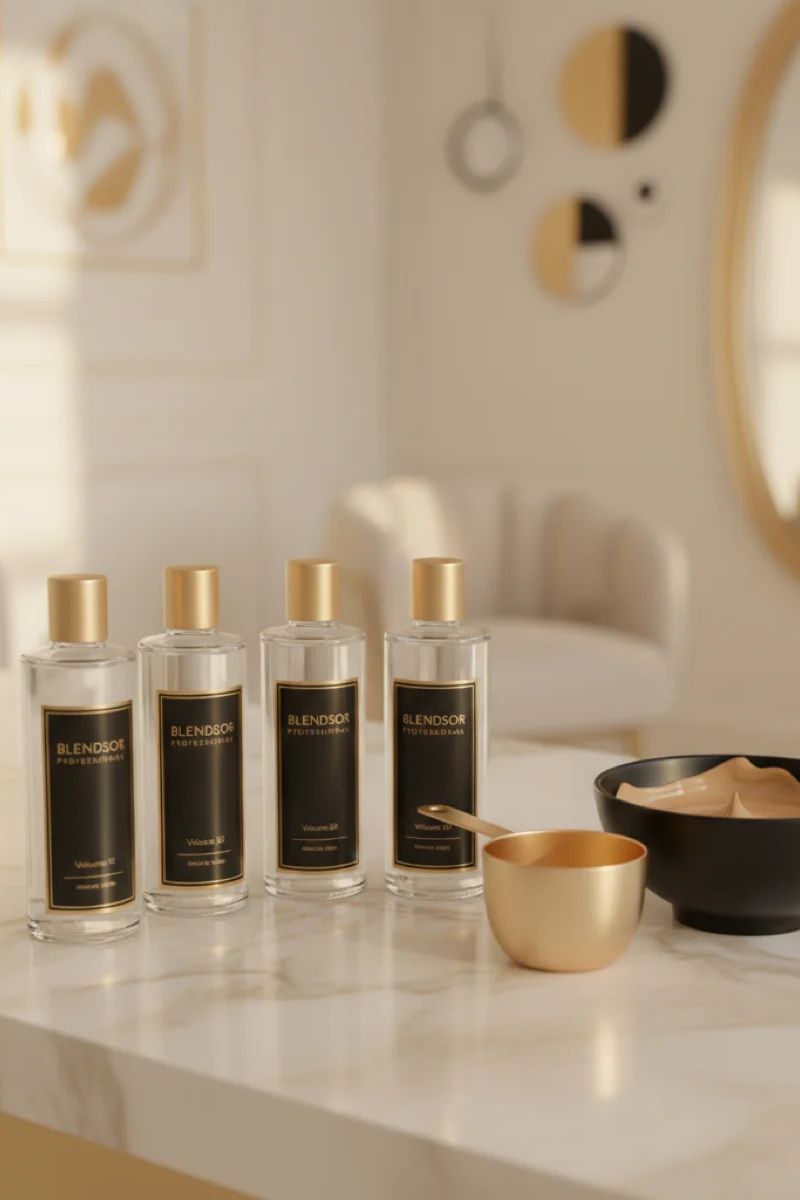
Developer is half the equation in hair coloring. Choosing the right volume is just as important as selecting the right dye. This article is part of our complete guide to hair colorimetry basics.
Quick summary: Hair color developers come in 4 volumes: 10 vol (deposit only, no lift), 20 vol (gray coverage, 1-2 levels of lift), 30 vol (highlights and dark bases, 2-3 levels) and 40 vol (fast bleaching, 3-4 levels, high damage risk). The professional rule is always use the minimum volume that achieves the goal.
What is developer and how does it work in hair coloring?
Developer (also called activator, oxidizer, or peroxide) is a hydrogen peroxide solution that opens the hair cuticle, activates dye pigments, and lightens natural hair pigment. Its concentration — measured in volumes or H₂O₂ percentage — directly determines how many levels can be lifted and at what potential cost to hair integrity.
What volume of developer lifts how many levels?
Lifting power by volume: 10 vol (3% H₂O₂) = 0-1 level; 20 vol (6%) = 1-2 levels; 30 vol (9%) = 2-3 levels; 40 vol (12%) = 3-4 levels. 20 vol is the industry standard because it balances lifting power with hair integrity across most services.
The 4 developer volumes every colorist must know:
| Volume | H₂O₂ % | Levels of Lift | Primary Use |
|---|---|---|---|
| 10 vol | 3% | 0-1 level | Color deposit, toning, soft gray blending (<30%) |
| 20 vol | 6% | 1-2 levels | Standard gray coverage (up to 100%), moderate changes |
| 30 vol | 9% | 2-3 levels | Highlights, balayage, resistant dark bases |
| 40 vol | 12% | 3-4 levels | Quick bleaching, very resistant hair (high damage risk) |
The professional rule: always use the minimum volume that achieves the goal.
When should you use each developer volume?
Volume choice depends on the service goal: 10 vol for depositing color or toning without any lift; 20 vol for gray coverage and 1-2 level changes; 30 vol for highlights and balayage; 40 vol only for bleaching very resistant hair with additional structural protection.
10 Volume (3%)
Ideal for:
- Depositing color without lifting
- Toning pre-lightened hair
- Soft gray blending (less than 30%): it blends grays into the rest, it doesn’t cover them. To cover, 20 vol is the minimum
- Refreshing mids and ends
Don’t use when: You need lift or to cover resistant grays.
20 Volume (6%)
The most versatile:
- Gray coverage up to 100%
- 1-2 level changes
- Color over color
- Foundation for most services
This is the industry standard for its balance between lifting power and hair integrity.
30 Volume (9%)
For specific techniques:
- Traditional highlights
- Balayage with moderate lift
- Dark bases that need more lift
- Very resistant virgin hair
Caution: Can damage fine or sensitized hair.
40 Volume (12%)
Advanced professional use:
- Quick bleaching
- Very resistant hair
- Specific techniques (with protection)
Warning: High damage risk. Avoid on treated or sensitive hair.
What factors determine the right developer volume?
Four variables determine the correct volume: hair condition (virgin vs treated vs damaged), porosity (high porosity requires lower volume), gray percentage (over 70% gray calls for 20 vol with pre-pigmentation and more time, not more volume) and desired lift level (no lift = 10 vol, 1-2 levels = 20 vol, 2-3 levels = 30 vol).
1. Hair Condition
- Virgin: You can use higher volumes
- Previously treated: Reduce the volume
- Damaged: Maximum 20 vol with treatment
2. Porosity
- High porosity: Absorbs quickly, use lower volume
- Low porosity: May need higher volume or heat
3. Gray Percentage
- < 30%: 20 vol to cover; 10 vol only if the goal is blending grays, not covering them
- 30-70%: 20 vol
- > 70%: 20 vol with pre-pigmentation and full processing time. More volume lifts more and deposits less, which is the opposite of what a gray hair needs. If you do need 30 vol, it’s because you’re also lifting the base two levels or more — that’s a lift goal, not a coverage one
4. Desired Lift Level
- No lift: 10 vol
- 1-2 levels: 20 vol
- 2-3 levels: 30 vol
- 3+ levels: Consider pre-lightening
What are the correct color-to-developer ratios?
The standard ratio is 1:1 (equal amounts of color and developer). High-lift tints require 1:2 to activate properly. Semi-permanents range from 1:1 to 1:1.5 depending on the brand. Use the developer mix calculator for exact proportions.
The ratio varies by technique:
| Technique | Ratio | Why |
|---|---|---|
| Global color | 1:1 | Standard balance between deposit and lift |
| Semi-permanent | 1:1 or 1:1.5 | More developer = less saturation, softer result |
| High-lift tints | 1:2 | Powder needs more developer to activate fully |
| Powder lightener | Per manufacturer | Varies by consistency: creamy (1:1.5) or fluid (1:2) |
| Toners / gloss | 1:2 or 1:3 | Greater dilution = less deposit, more translucent result |
When to use 1:1, 1:1.5, or 1:2
The ratio directly affects the mixture’s consistency, processing time, and color saturation:
- 1:1 — The mixture is creamier and denser. Best for full-head applications where maximum coverage and color saturation are the goal. Peroxide acts at a higher concentration.
- 1:1.5 — The intermediate ratio. Good for open-air techniques (balayage, babylights) where the mixture needs extra fluidity for even distribution.
- 1:2 — The mixture is more liquid and fluid. Required for high-lift tints (powder lightener) and some toners. At this ratio, pigment deposits more translucently and results look softer.
Pro tip: If you always use the same ratio regardless of technique, you’re working “by feel” on a part of the process where precision makes a real difference. A 0.1g precision scale costs less than $15 and immediately improves result consistency.
What happens when you use the wrong volume in real salon scenarios?
The consequence of the wrong developer volume depends heavily on the situation: with resistant grays it means insufficient coverage; with fine bleached hair it means breakage. These are the most common real-world scenarios where an incorrect volume creates problems.
Scenario 1: Client with 80% gray and 10 vol
Imagine a client with 80% gray distributed all over the head. You use 10 vol because it’s “gentler.” The result: the gray doesn’t cover because gray hair’s cuticle hasn’t opened sufficiently for pigment to penetrate. The gray resists.
The solution: For resistant gray at high percentages, the minimum is 20 vol. If the gray is glassy (shiny, very resistant), consider 20 vol with full processing time (45 minutes) or 25 vol by mixing equal parts of 20 and 30 vol from the same brand.
Scenario 2: Balayage on fine hair with 30 vol
You have a client with fine, delicate hair who wants balayage. You use 30 vol because “it’s for highlights.” After 30 minutes, the highlighted sections are breaking and the hair feels like cotton.
The solution: On fine, sensitized, or previously treated hair, drop to 20 vol even when doing balayage. Open-air technique without foil already generates significant lift on its own. Developer volume is a parameter you should always adjust to hair condition, not just to the technique.
Scenario 3: Darkening over pre-lightened hair with 20 vol
A client wants to go back to brunette after being blonde. You use dark dye with 20 vol. The result: the color goes in much darker and more intensely than expected, because bleached hair has high porosity and absorbs pigment like a sponge.
The solution: To tone or deposit color on pre-lightened hair, use 10 vol or even 6 vol. The goal is deposit — not lift. More developer than needed will open the cuticle further and cause excessive pigment uptake.
| Situation | Common mistake | Correct volume |
|---|---|---|
| Resistant grays (>60%) | Using 10 vol | 20 vol minimum, 45 min |
| Fine hair + highlights | Using 30 vol | 20 vol |
| Toning pre-lightened hair | Using 20 vol | 6-10 vol |
| Gray coverage + lift 1 level | Using 10 vol | 20 vol |
| Bleaching damaged ends | Using 30-40 vol | Stop and treat first |
What are the most common developer volume mistakes?
The four most frequent mistakes: always using 30 vol “just in case” (unnecessary damage), mixing developers from different brands (incompatible stabilizers), not adjusting for individual hair condition, and ignoring porosity which directly affects the final result.
- Always using 30 vol “just in case”: Causes unnecessary damage
- Mixing developers from different brands: Can alter results — if you need to switch brands, use our hair color converter to check shade compatibility first
- Not adjusting for hair condition: Every client is different - learn to diagnose in our color level guide
- Ignoring porosity: Directly affects the outcome
For more common formulation mistakes, check our guide on color formulation errors.
How Blendsor Helps
Blendsor’s AI analyzes your client’s photos and recommends:
- Optimal developer volume
- Color to developer ratio
- Processing time
- Specific precautions
All based on hair condition analysis and the desired result.
Frequently Asked Questions
What developer volume should I use for gray coverage?
Use a minimum of 20 volume (6%) for gray coverage. This volume opens the cuticle enough for pigment to penetrate resistant gray hairs. For very stubborn grays above 70% coverage, combine 20 volume with a pre-pigmentation technique.
Can I mix different developer volumes together?
Yes, mixing developers from the same brand is a valid technique for achieving intermediate volumes. For example, mixing equal parts of 20 and 30 volume yields approximately 25 volume. Never mix developers from different brands, as stabilizers may be incompatible.
What happens if I use a higher developer volume than needed?
Using more volume than necessary causes unnecessary damage to the hair fiber, excessive lift of natural pigment, and can alter the desired reflect. The professional rule is to always use the minimum volume that achieves the goal.
Does developer expire or lose potency?
Yes, developer loses potency over time, especially when exposed to heat or direct light. A developer with a loose cap loses hydrogen peroxide concentration, reducing its lifting power and potentially causing inconsistent results.
Recommended Professional Developers
These are the developers that deliver the best performance based on our experience and hundreds of colorists:
- Wella Welloxon Perfect — The most consistent on the market. Available in 1.9%, 4%, 6%, 9% and 12%. Predictable results with the entire Koleston line.
- L’Oreal Oxydant Creme — Creamy texture that doesn’t drip. Compatible with Inoa, Majirel and Dia Light. Excellent for open-air techniques.
- Schwarzkopf Igora Royal Developer — Stable formulation with conditioning agents. Ideal for full services with Igora Royal.
Tip: Always use the developer from the same brand as your dye. Stabilizers are designed to work together and results are more predictable.
Try our developer-dye mix calculator to get the exact ratio for your case. And if you want to predict what happens when combining two shades, use our hair color mixing calculator.
This article contains affiliate links. If you purchase through them, we receive a small commission at no additional cost to you. We only recommend products that trusted professionals endorse.
Mastering developers is what separates a good colorist from an excellent one.
Related articles:
Related articles

Practice with our colorimetry tools
Calculators, neutralization wheel, AI consultation...
The Blendsor newsletter
Color techniques and trends for professionals. No spam.
You know the theory. What about today's case?
Send a photo to the Blendsor advisor and get an answer grounded in colour theory: toner, developer and timing, with the brands on your shelf.
Ask about your caseWritten by the Blendsor team
Professional hair colorimetry experts with experience in AI-assisted formulation. We combine color science, salon practice and technology to help colorists formulate with precision.