How to Switch Professional Hair Color Brands Without Losing Results
Step-by-step guide to switching hair color brands. 7-brand comparison matrix, transition process, and conversion tools for professional colorists.
Blendsor
Blendsor Team
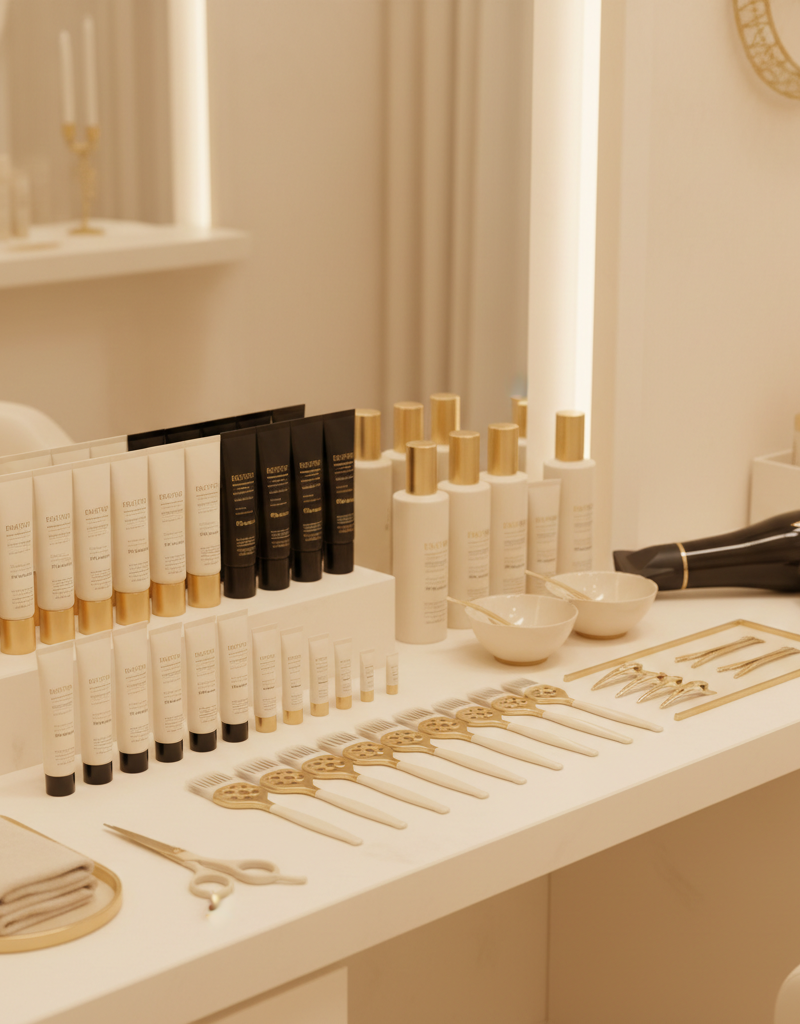
Switching hair color brands requires a systematic approach: inventory your current formulas, map shade equivalences with a conversion chart, test your top 10 formulas with strand tests, and transition gradually over 2-3 months while keeping both product lines in stock. The main challenges are different nomenclatures between brands, incompatible developers, and proprietary pigment systems that affect processing time and final results.
Have you ever been forced to switch hair color brands because your distributor stopped carrying your line? Or found a better price on another professional brand and wondered if you could make the transition without losing the formulations you’ve perfected over years?
Switching brands is one of the most delicate decisions for a salon. You’re not just changing products, you’re changing the entire color system you’ve built your reputation on. But when done correctly, it can open doors to better value, expanded shade ranges, or simply more reliable supply.
This guide will walk you through the complete process of switching brands without sacrificing the quality your clients expect. From mapping equivalences to managing inventory during the transition.
Why Salons Switch Brands
Brand switching isn’t always a choice. Sometimes it’s a necessity. Here are the five most common reasons professional colorists make the change:
1. Distributor Changes Terms or Stops Carrying the Line
This is the most frustrating scenario. Your distributor suddenly changes suppliers, increases minimum orders, or completely drops your preferred brand. You’re left scrambling for alternatives with little warning.
2. Better Value in Another Brand
Professional color isn’t cheap. When you discover another brand offers comparable quality at 20-30% less cost, the math becomes hard to ignore. Over a year, that difference can be substantial for a busy salon.
3. Training or Affinity with a New Brand
You attended a workshop, fell in love with a brand’s educational approach, or saw their techniques transform your work. The emotional and technical connection becomes stronger than brand loyalty to your current line.
4. Product Reformulation Ruins Your Formulas
Remember when Redken Shades EQ changed their formulation in recent years? Colorists worldwide had to recalibrate formulas they’d used for years. Sometimes a reformulation is the push you need to explore alternatives.
5. Broader Shade Range Available
Your current brand has 20 shades. Another has 30, including that perfect muted rose or dimensional ash you’ve been trying to create by mixing three tubes. Sometimes you need more tools in your palette.
Understanding hair colorimetry basics is essential before switching brands, as it helps you translate formulas across different nomenclature systems.
Risks of Switching Unprepared
Switching brands without preparation is like driving in a foreign country without a map. The roads exist, but the signs are different. Here’s what goes wrong:
Different Nomenclature Systems
Not all brands speak the same language. While most follow the international level.reflect system, the reflects themselves vary significantly.
Critical example: In Schwarzkopf Igora Royal, .5 = gold and .7 = copper. In most other brands, .3 = gold and .4 = copper. Use your old formula codes with new products, and you’ll get completely different results.
Incompatible Developers Between Brands
Each brand’s developer is formulated to work with their specific dye chemistry. Mixing Wella dye with L’Oreal developer might work in a pinch, but the processing time, lift, and deposit will be unpredictable.
According to research from the Society of Cosmetic Chemists, color developers contain proprietary stabilizers and pH adjusters calibrated for their specific dye formulations. Using mismatched systems can result in uneven color deposit or reduced lift.
Proprietary Pigments by Each Manufacturer
Wella’s ash isn’t Matrix’s ash. Each brand uses different pigment combinations to achieve their reflects. A 7.1 in one brand might be cooler, stronger, or more violet-toned than another brand’s 7.1.
Unpredictable Results Without Strand Tests
What worked perfectly in Brand A might turn brassy, muddy, or too intense in Brand B. The only way to know is to test. Skipping this step means using your clients as test subjects.
Different Processing Times
Some brands develop color in 30 minutes. Others need 40 or even 45 minutes for full saturation. Rush a new brand, and you’ll get underdeveloped color. Leave it too long, and you risk damage without added benefit.
Step-by-Step Brand Transition Process
This five-step process takes the guesswork out of switching. Follow it systematically, and you’ll avoid the most common mistakes.
Step 1: Inventory Your Current Formulas
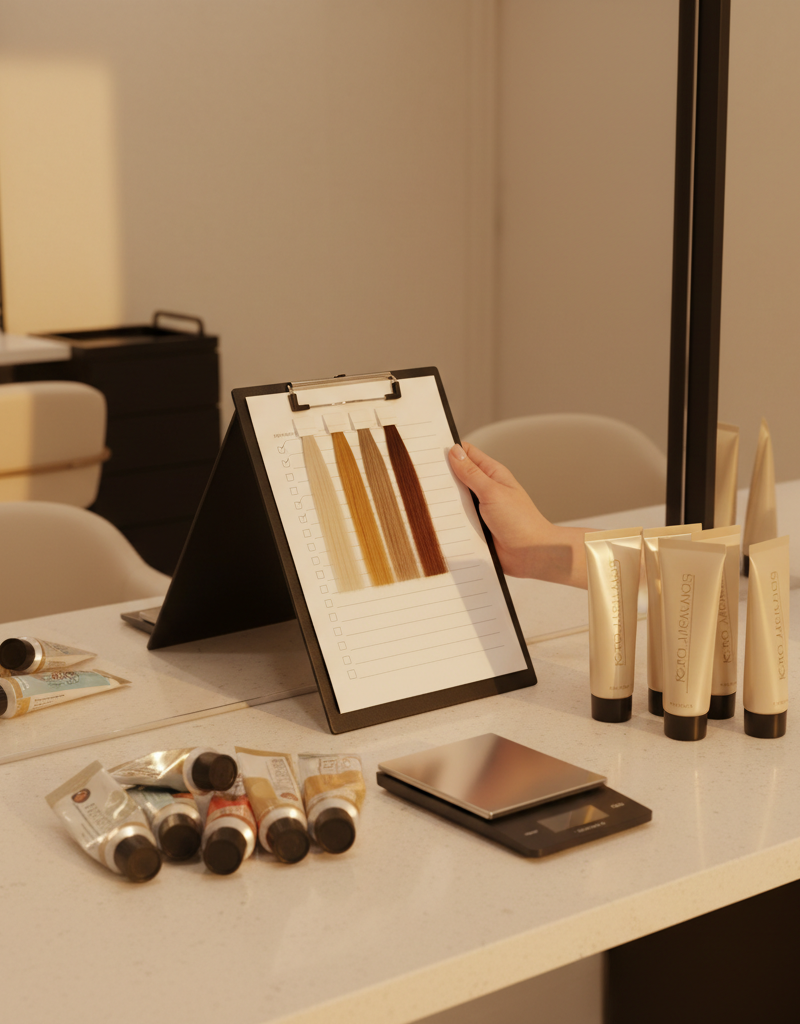
Before you switch a single tube, document everything you currently use. Create a spreadsheet with:
- Client name
- Current formula (exact codes)
- Developer volume
- Processing time
- Special notes (resistant roots, porous ends, etc.)
Focus on your top performers: The 10-15 formulas you use most often. These are your priority translations. The occasional specialty formula can wait.
Step 2: Map Equivalences with a Conversion Tool
This is where technology saves you hours of guesswork. Use our hair color converter to instantly map your formulas to the new brand.
How it works: Select your current brand and shade. The converter shows equivalent shades across 10 professional brands, including Wella, Schwarzkopf, L’Oreal, Matrix, and more.
Example: You use Wella Koleston 7/43 (medium blonde red-gold). Switch to L’Oreal Majirel, and the converter shows 7.43 as the direct equivalent. Same level, same reflects, different formulation.
The converter includes 254 professional shades and accounts for brand-specific nomenclature quirks like Schwarzkopf’s non-standard reflect numbering.
You can explore specific brand conversions directly:
Step 3: Mandatory Strand Tests
This is non-negotiable. No matter how confident the equivalence looks on paper, test it on real hair before applying it to a client’s head.
Process for strand testing:
- Select your top 10 formulas from Step 1
- Prepare test swatches at different starting levels (5, 6, 7)
- Mix the new brand’s equivalent formula exactly as mapped
- Apply and process according to the new brand’s instructions
- Document results with photos and notes
What to evaluate:
- Does the level match your expectation?
- Is the tone warmer, cooler, or identical?
- Does it process faster or slower?
- Is the coverage (especially gray coverage) comparable?
Budget 2-3 hours for this testing phase. It’s time well spent compared to months of unpredictable client results.
Step 4: Gradual Transition
Don’t switch your entire color bar overnight. Start with low-risk services and expand as you gain confidence.
Transition timeline:
Week 1-2: Simple one-process color on regular clients who trust you and understand you’re transitioning brands.
Week 3-4: Gray coverage, dimensional color, and glossing services.
Week 5-6: Highlights, balayage, and correction work once you’ve mastered the new formulas.
Week 7-8: Full transition. Your old brand becomes the backup, not the primary.
Step 5: Adjust Timing and Developer
Each brand has unique processing characteristics. Your reliable 35-minute timing might need adjustment.
Key variables to monitor:
- Development speed: Does color develop visibly faster or slower?
- Peak saturation: When does the color reach its maximum intensity?
- Gray coverage: Does it require a full 45 minutes, or does 40 suffice?
Check our guide to developer volumes to understand how different brands’ developers affect lift and deposit.
Keep detailed notes during the first month. By week 8, you’ll have your new timing system dialed in.
7-Brand Professional Comparison Matrix
This table compares the most popular professional brands across key specifications. Use it to understand what changes when you switch systems.
| Brand | Permanent Line | Demi Line | Perm. Shades | Demi Shades | Levels | Nomenclature | Developer |
|---|---|---|---|---|---|---|---|
| Wella | Koleston Perfect ME+ | Color Touch | 26 | 17 | 2-10 | Level/Reflect (5/1) | Welloxon |
| Schwarzkopf | Igora Royal | Igora Vibrance | 30 | 16 | 1-10 | Level-Reflect (5-1). Non-standard: -5=gold, -7=copper | Igora Developer |
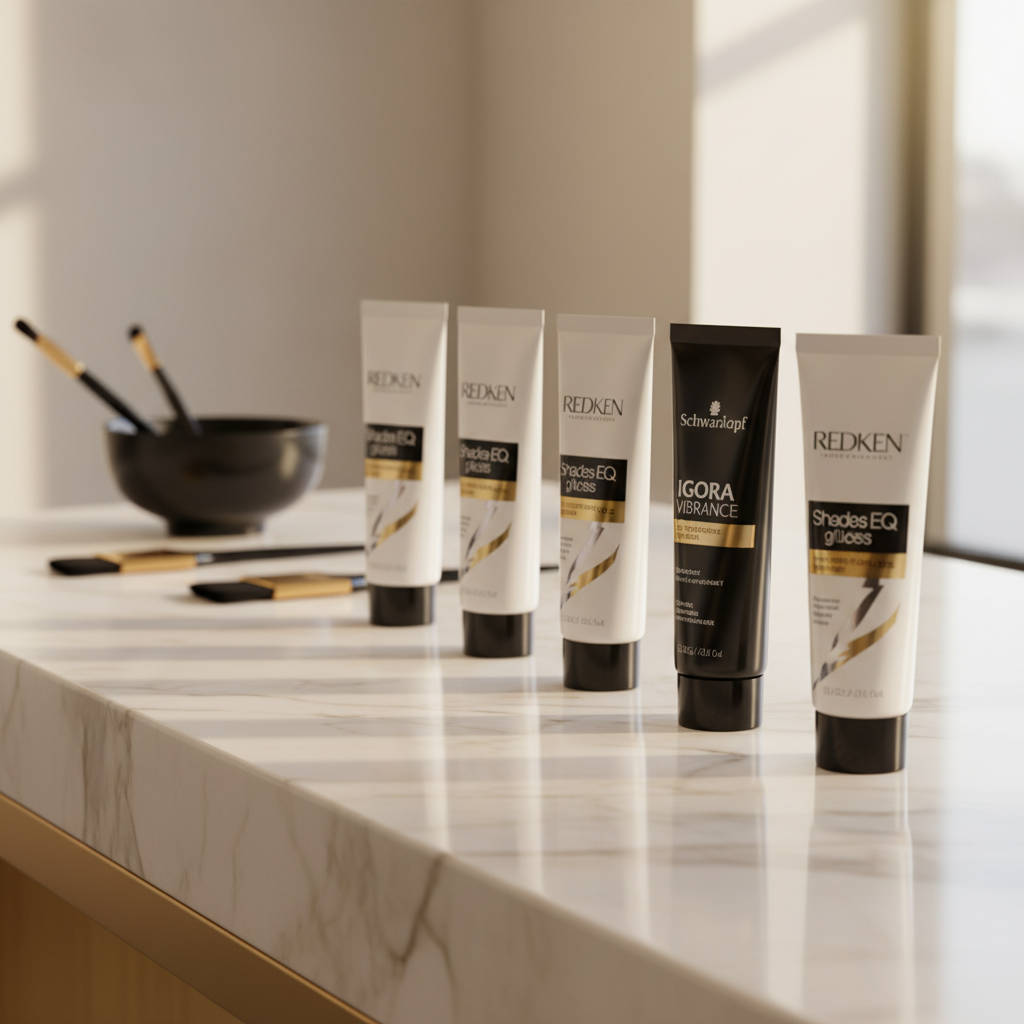
| Redken | — | Shades EQ Gloss | — | 20 | 3-9 | Level+Letter (05C, 09T) | Processing Solution |
| Matrix | SoColor Pre-Bonded | — | 21 | — | 2-10 | Level+Letter (5A, 6MR) | Cream Developer |
| L’Oreal | Majirel | Dia Light/Richesse | 24 | 16 | 2-10 | Level.Reflect (5.1, 6.34) | Oxydant |
| Goldwell | Topchic | — | 22 | — | 2-10 | Level+Letter (5G, 6K) | Topchic Developer |
| Joico | LumiShine | — | 22 | — | 2-10 | Level+Code (5NA, 6NR) | LumiShine Developer |
Key observations:
- Schwarzkopf uses non-standard reflect numbering. If you’re switching to or from Igora, pay extra attention to gold and copper reflects.
- Redken focuses exclusively on demi-permanent with Shades EQ. If you need permanent color, you’ll need a different brand or add a permanent line.
- Wella and L’Oreal offer the most comprehensive systems with both permanent and demi options and extensive shade ranges.
The Converter as a Professional Tool
Let’s walk through a practical example of using the hair color converter during a brand transition.
Scenario: You currently use Wella Koleston Perfect and want to switch to L’Oreal Majirel for cost savings.
Your most-used formula: 7/43 (medium blonde red-gold) mixed with 7/03 (medium blonde natural-gold) in a 60:40 ratio for dimensional blonde.
Process:
- Open the hair color converter
- Select Wella Koleston as your current brand
- Enter 7/43 in the shade search
- View equivalents across all brands
- Find L’Oreal Majirel 7.43 as the direct match
- Repeat for 7/03 → L’Oreal Majirel 7.03
Result: Your new formula is Majirel 7.43 (60%) + 7.03 (40%) with the same developer ratio and processing time as a starting point.
The converter includes 10 major professional brands and 254 individual shades, covering everything from standard tones to specialty reflects like pearl, iridescent, and matte.
Pro tip: The converter also suggests alternative matches when direct equivalents don’t exist. If your favorite specialty reflect isn’t available in the new brand, it shows the closest two-shade mix to replicate it.
Managing Inventory During Transition
Brand transition isn’t instantaneous. You’ll need a strategic approach to inventory management that balances cost control with service continuity.
Overlap Period: 2-3 Months
Plan for 8-12 weeks where both brands coexist in your color bar. This allows you to:
- Complete transition clients gradually
- Handle corrections or touch-ups with the original formula
- Test new formulas without service interruption
Minimum Stock in New Brand
Don’t buy your entire shade range immediately. Start with:
- Top 10-15 most-used shades: These cover 70-80% of your daily services
- Developer in all volumes: 10, 20, 30 vol at minimum (40 vol if you use it)
- Natural base shades: Essential for mixing and dilution (6.0, 7.0, 8.0)
Add specialty shades as you need them. This approach minimizes upfront investment and reduces waste if certain equivalences don’t work as expected.
Calculate Transition Cost
Use our salon pricing calculator to model the financial impact of the switch. Input your average monthly color usage and compare costs between brands.
Real cost factors:
- Product price per tube: Can vary 20-40% between brands
- Developer cost: Often overlooked but significant over time
- Waste during transition: Testing and incorrect formulas
- Time investment: Your time has value, factor in learning curve
For most salons, switching to a 25% less expensive brand pays for itself within 3-4 months even accounting for transition costs.
Don’t Discard Old Stock
Your old brand becomes your safety net. Keep it for:
- Existing formulation clients: Those who need exact color matches
- Corrections: If something goes wrong with the new formula
- Special requests: When a client specifically asks for “the same as last time”
Once you’re confident in your new formulas (usually month 3-4), phase out the old stock through regular use or donate to beauty schools.
Learn more about optimizing salon costs in our guide to hair coloring service pricing.
Frequently Asked Questions
How long does it take to transition to a new brand?
A complete brand transition takes 8-12 weeks for most salons. Week 1-2 focuses on strand testing and simple applications. Weeks 3-6 expand to complex services. By week 8, you should be confident enough to use the new brand as your primary line, with the old brand as backup.
Can I mix products from two brands during transition?
No, never mix dyes or developers from different brands. Each manufacturer’s system is internally calibrated. The chemistry, pH levels, and processing times are designed to work together. Mixing brands can result in unpredictable color development, poor gray coverage, or inconsistent lift. During transition, use one brand’s complete system per client.
How do I explain the brand change to clients?
Be transparent and professional. Most clients care about results, not brand names. Say: “We’re transitioning to [new brand] for [reason: better education/expanded shades/superior quality]. We’ve tested your formula extensively, and you’ll notice even better results.” Focus on benefits to them, not logistics for you.
Is there a tool to compare shades between brands?
Yes. Our hair color converter compares shades across 10 professional brands including Wella, Schwarzkopf, L’Oreal, Matrix, Goldwell, Joico, Redken, Paul Mitchell, Pravana, and Pulp Riot. It includes 254 professional shades with direct equivalences and suggested alternatives when exact matches don’t exist.
In Summary
Switching professional hair color brands successfully requires:
- Systematic preparation: Document current formulas before you start
- Reliable conversion tools: Use a professional converter, not guesswork
- Mandatory testing: Strand test your top 10 formulas before client application
- Gradual transition: 8-12 weeks with both brands in stock
- Cost analysis: Calculate true cost including time and waste
- Awareness of differences: Nomenclature, processing times, and pigment systems vary
The risk of switching unprepared is unpredictable client results and damaged reputation. The benefit of switching strategically is better value, expanded options, or stronger supplier relationships without sacrificing quality.
Want to simplify color formulation regardless of brand? Try Blendsor free. Our AI analyzes hair and suggests formulas based on colorimetry principles that work across any professional brand.
And you, what was the biggest challenge when you switched brands?
Related articles
Practice with our free tools
Calculators, neutralization wheel, AI consultation...
Apply this theory with precision
Blendsor analyzes 70+ variables and generates exact formulas based on real colorimetry. Try our free color consultation or download the app.
Download free