Neutralize a Red Undercoat Without Bleaching
A red-orange undercoat won't cancel out with one corrector. How to balance matte and ash without lightening further, and the test that comes first if henna is suspected.
Blendsor
Blendsor Team
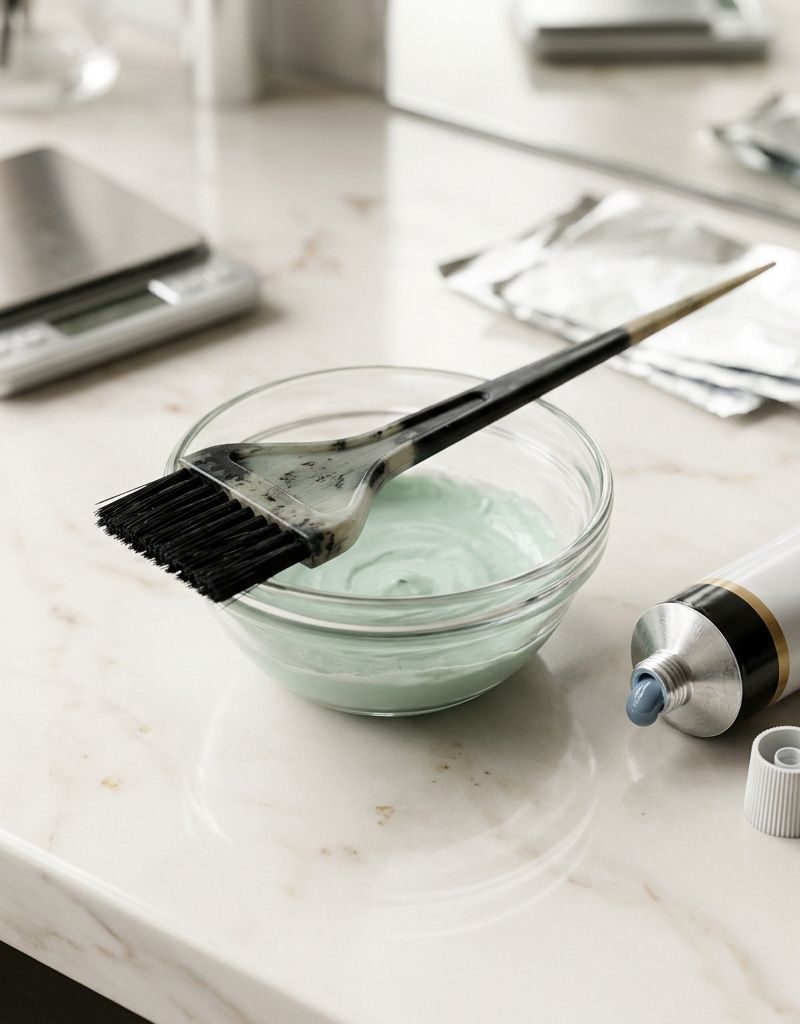
Has a red-orange undercoat landed in your chair that you can’t lift any further?
If you’ve been doing color for a while, you know not every red gets solved with another lightening session. Sometimes the fiber says stop. Sometimes it’s the timeline. And sometimes it’s something more serious: suspected henna, and then lightening isn’t even on the table.
Picture the typical case: level 5-6, a henna history from a couple of years back that nobody can fully confirm, and the client just wants the red to stop reading through. You don’t reach for another lightening session. You reach for correction on top.
Here’s how to neutralize that undercoat working on top, without lightening again — and the one step that comes before mixing anything.
Quick summary: a red-orange undercoat doesn’t cancel out with a single corrector. Matte (green) neutralizes red and ash (blue) neutralizes orange; an undercoat carrying both temperatures needs both families, weighted toward whichever dominates. If henna or vegetal color is suspected, the incompatibility test comes before anything else, and lightening is off the table.
Why won’t a natural shade alone neutralize a red undercoat?
A natural shade alone doesn’t carry the complementary pigment a red-orange undercoat needs: it adds coverage and depth, but nothing that cancels the red or the orange showing through underneath. The result looks right in the bowl and reads reddish on the head the moment light hits it. For the full mechanism behind why that undercoat shows up and at which levels it’s strongest, see the color correction guide.
Before mixing anything: the incompatibility test
If there’s any suspicion of henna, vegetal color, or a product the client doesn’t fully remember, nothing goes on top of that undercoat — not even a gloss, not even a light deposit — without the incompatibility test done first. This isn’t textbook caution: it detects whether something in the fiber will react with the service’s chemistry, and decides whether it’s safe to work on top at all.
The full protocol, signal by signal, lives in incompatibility test positive: what to say and do. What matters for this case: if the history mentions henna or vegetal color, the chemical path left is depositing color on top — never lightening. That line isn’t drawn by caution; it’s drawn by the fiber.
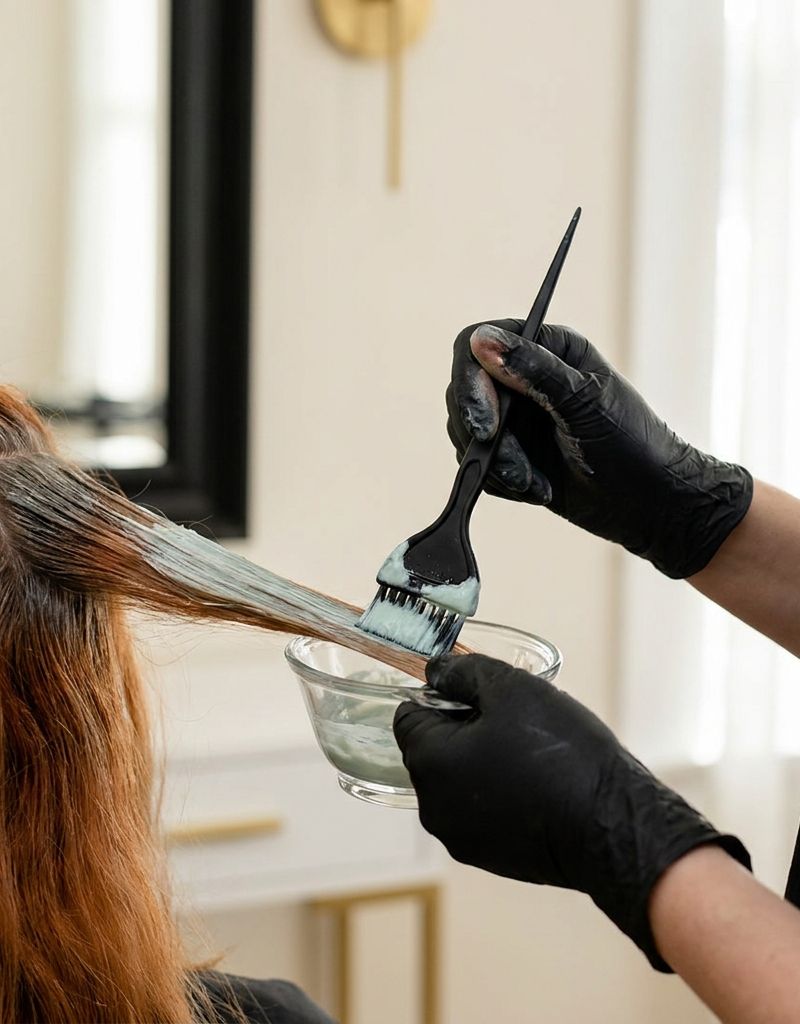
Why does it take more than one corrector?
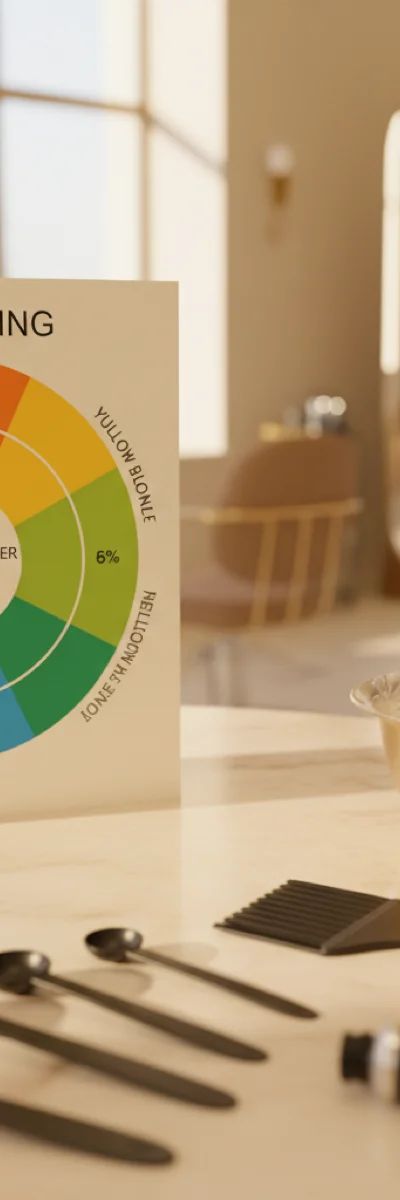
It takes more than one corrector because a red-orange undercoat isn’t a single color: it blends the temperature of red and the temperature of orange, and each needs its own opposite. Against red goes matte, which is green. Against orange goes ash, which is blue. The brand itself publishes it: “To neutralise an orange undercoat: use blue / To neutralise a red undercoat: use green,” states Majirel’s product information sheet. An undercoat carrying both needs the mix with both, not more of one alone.
What changes between brands isn’t the family, it’s the digit that names it:
| Family (and what it neutralizes) | L’Oréal (Majirel) | Wella (Koleston Perfect) |
|---|---|---|
| Ash = blue → neutralizes orange | ,1 | /1 |
| Matte = green → neutralizes red | ,7 | /2 |
| Gold = yellow | ,3 | /3 |
| Violet = purple → neutralizes yellow | ,2 | /6 |
The Koleston Perfect usage booklet confirms the same assignment on the Wella side: “/1 Ash (blue/green), /2 Matt (green), /3 Gold (yellow).” Always translate to your line’s chart before weighing anything: the family is universal, the digit isn’t.
How to balance matte and ash without lightening
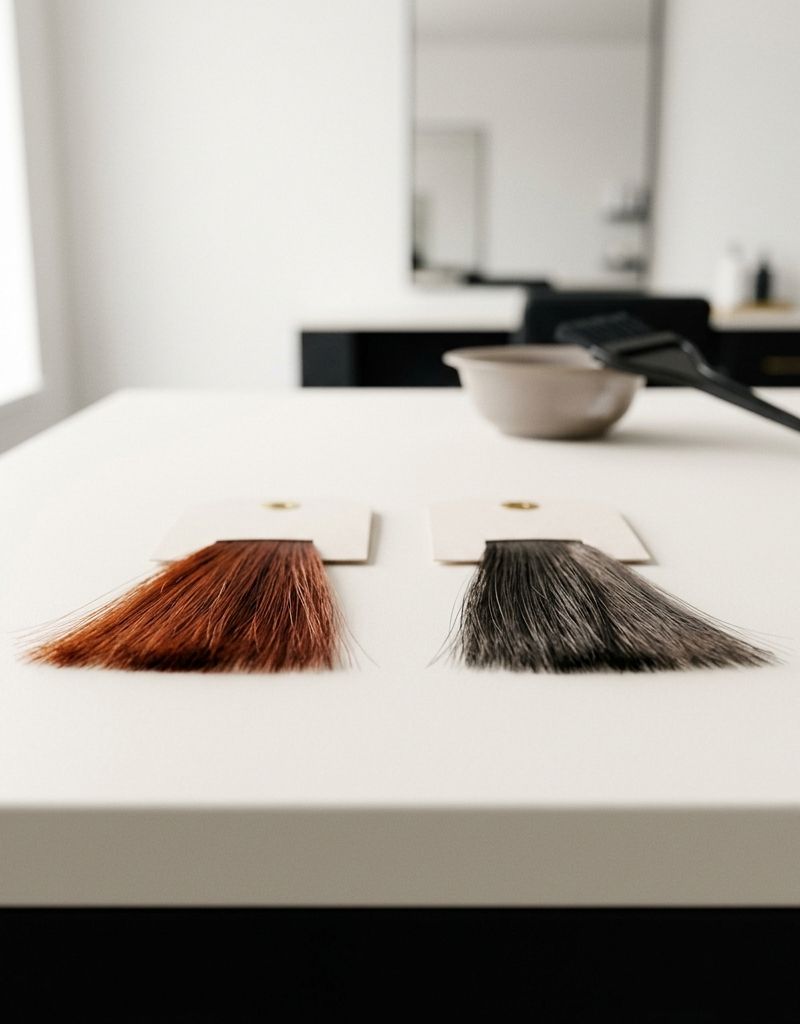
The balance is decided by which color dominates, not by a fixed ratio. Hold the strand under natural light: if it reads more red than orange, matte carries more weight; if it reads more orange, push the ash. Over the natural base of the target level:
- Diagnose what dominates: pure red, pure orange, or a mixed undercoat (the most common case at levels 5-6).
- Build the base: natural of the target level + matte + ash, with the dominant corrector at the higher proportion.
- Respect your brand’s ratio: Majirel mixes at 1:1.5, Koleston Perfect at 1:1. Don’t guess it, don’t borrow it from another line.
- Strand test, always: validate on a hidden section before applying to the whole head.
- The developer volume is decided last, not first: if henna was suspected, the incompatibility test has to come back clean first; only then do you choose the low volume a toning service calls for, never one meant to lighten. The developer and volumes guide explains how to choose it based on the fiber.
This order — diagnose, balance, strand test, and the developer last — is what separates “neutralizing on top” from trying to fix it with more lightening.
The ,13 mistake that isn’t matte
A ,13 isn’t matte, even though the “1” invites you to think so. It’s ash plus gold: blue plus yellow. Majirel’s own sheet splits the reflects like this — “,1 ASH” (blue), “,3 GOLD” (yellow), “,7 MAT” (green) — and the green, the one that works against red, stays with ,7. On a red-orange undercoat a ,13 does part of the job: its ash works the orange half. What it doesn’t carry is the green, which is why the red still reads through.
It’s a mistake that shows up more than it should, precisely because the digit seems to point there. The rule that keeps it straight: matte against red is ,7 in L’Oréal and /2 in Wella, and no other digit in that family substitutes for it.
The two risks of overdoing it
Overdoing ash doesn’t give you more cold, it gives you dull grey: excess blue over an undercoat that’s still red-orange strips light instead of correcting tone. Overdoing matte doesn’t give you more neutral, it gives you olive, especially in the more porous zones of mids and ends, where the corrector penetrates faster and builds up. It’s the classic case of a client with more porous ends than roots: the same mix that reads neutral at the root can tip into matte overload at the ends within minutes. Both risks show up in the strand test before they show up on the whole head — one more reason not to skip that step.
Three different tests, and none replaces another
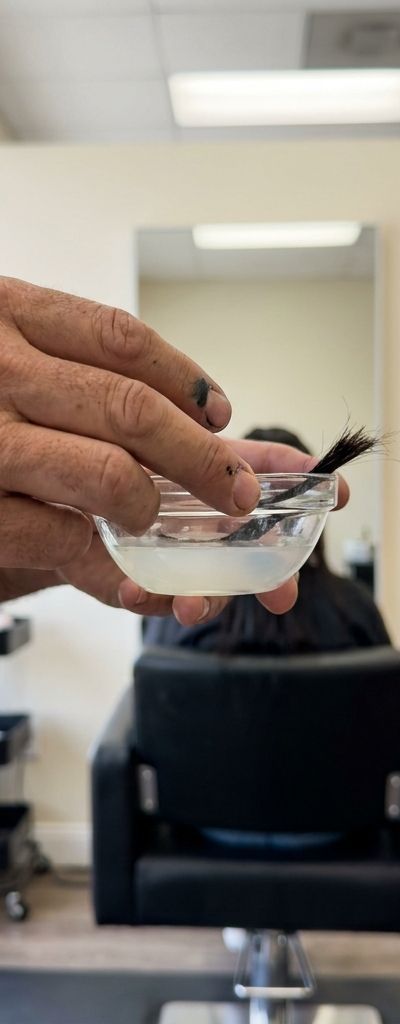
Worth separating them, because they overlap in this service. The allergy test goes on the skin, 48 hours ahead: the Koleston Perfect usage booklet asks for it in those words — “we recommend that a skin allergy test is done 48 hours before coloring” — and it applies even to ammonia-free or tone-on-tone color. The incompatibility test goes on a cut strand and looks at something else: whether there are metals in the fiber. And the strand test looks at color: how your mix behaves on that specific fiber.
Having done one does not cover the other two.
Frequently asked questions
Wouldn’t it be faster to lighten a bit more and remove the red that way?
It depends on the fiber and the history. If henna or vegetal color is suspected, lightening is off the table: that undercoat doesn’t get bleached, clean metal test or not. If there’s no such suspicion and the fiber can take it, another lightening session is a real option — but that’s a different decision from the one in this article, which starts from lifting further not being the path.
What if the incompatibility test comes back positive?
Nothing goes on that day. The full protocol — what to say, what to offer instead, and when the service can be revisited — lives in incompatibility test positive: what to say and do.
Do matte and ash get premixed or applied separately?
They get premixed in the same bowl, together with the natural base, in the proportion the diagnosis calls for based on which color dominates. Applying them in separate passes complicates control of the result without adding anything in return; what does deserve its own step is the strand test, always before the global application.
In summary
- A red-orange undercoat needs two correctors: matte against red, ash against orange. Neither substitutes for the other.
- The incompatibility test comes first if henna or vegetal color is suspected — and if it’s positive, lightening is off the table.
- The digit changes by brand:
,7//2is matte, not,13, which is ash plus gold. - The strand decides the balance, not a fixed recipe: whichever color dominates carries more weight.
- The developer is chosen last, within the toning range, never the lightening one.
Calculate the mix with Blendsor
You read the strand: what dominates, how the fiber’s holding up, what’s worth checking in the history. Blendsor cross-references the starting level with your brand and suggests the exact split between matte and ash for that specific undercoat.
What’s the most stubborn red undercoat you’ve had to solve without being able to lighten it any further?
Related articles
Practice with our colorimetry tools
Calculators, neutralization wheel, AI consultation...
The Blendsor newsletter
Color techniques and trends for professionals. No spam.
A client in the chair right now?
The Blendsor advisor gives you the precise formula for this technique with your salon's brands — and saves it to your client's card.
Ask about your caseWritten by the Blendsor team
Professional hair colorimetry experts with experience in AI-assisted formulation. We combine color science, salon practice and technology to help colorists formulate with precision.