Patchy velvet blonde: the problem isn't the toner, it's the base
Velvet blonde comes out patchy because roots, mid-lengths, and ends don't start from the same underlying pigment. Learn to read the base zone by zone before toning.
Blendsor
Blendsor Team
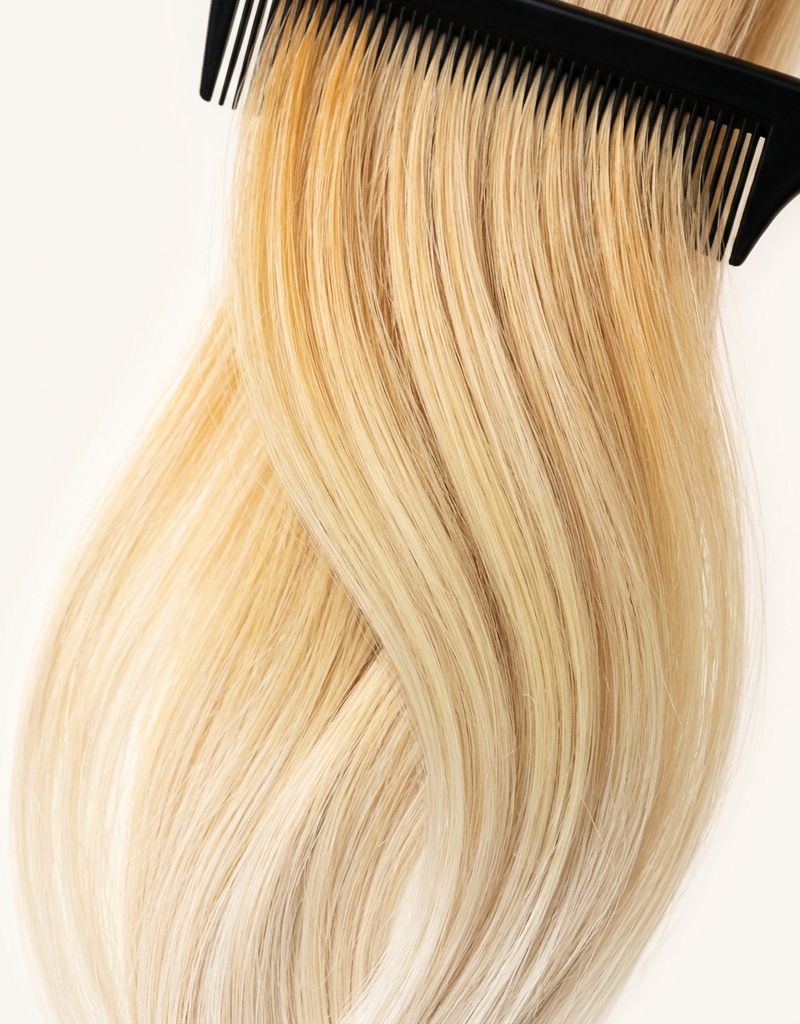
You reached the lift you needed. The bleaching went well. Then you tone the velvet blonde and the result comes out patchy: roots cooler, mid-lengths with a golden cast you didn’t ask for, ends nearly grey. The toner takes the blame. But it’s almost never the toner.
Patchy velvet blonde is, in most cases, a base-reading problem, not a toner formulation problem. If roots, mid-lengths, and ends don’t start from the same underlying pigment, no toner can even them out. What you see at the end is proof of what happened before.
In this article we explore why the underlying pigment is almost never uniform from root to end, how to read it zone by zone, and what toning decisions change the result when zones are uneven.
If you’re looking for the base velvet blonde formula — target lift level, toner family, ratios — that content is already in Velvet Blonde: How to Formulate the Low-Saturation Satin Blonde. This article is the step before: diagnosing the base.
Why the underlying pigment is almost never uniform from root to end
Think about the last bleaching service you did. Did you apply lightener at the same time on roots and ends? Was the heat identical across all zones? Did the hair have the same chemical history from root to end?
The answer to all three questions is no. And that’s where the problem lives.
Roots lift faster
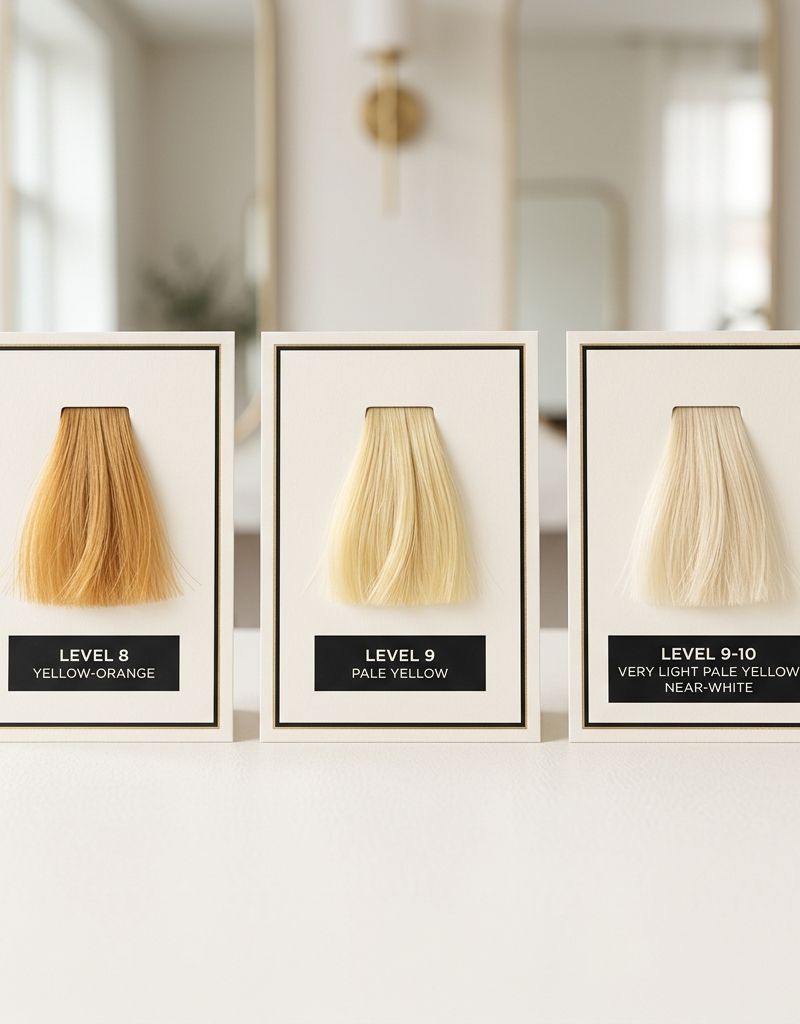
Regrowth roots receive body heat from the scalp. That heat accelerates the oxidation reaction. The result: roots tend to reach a lighter underlying pigment — level 9 or even 9-10 — before the rest of the hair.
On top of that, new hair has no chemical history. It’s virgin, with an intact cuticle, and responds to lightener in a more predictable, consistent way.
Mid-lengths carry the hair’s history
Mid-lengths are the most complex zone. This is where history accumulates: previous colour, treatments, sun exposure, straightening. All of that history alters porosity and how the hair responds to lightener.
Hair with previous colour in the mid-lengths may resist the lift and stay at a yellow-orange underlying pigment (level 7-8) while the roots are already at a pale yellow (level 9). Or the opposite: it can absorb so quickly that the zone becomes irregular within itself.
Ends are usually the most porous
Ends have years of friction, heat, and product behind them. The cuticle is more open. That can mean two opposite things depending on the situation:
- Very porous ends with no resistance: they lift quickly, but they also absorb toner with disproportionate intensity. The velvet can turn grey at the ends while mid-lengths stay warm.
- Ends with previous colour buildup: they resist the lift and stay at warmer underlying pigment even when roots and mid-lengths are already where you want them.
The practical result is always the same: three zones, three different underlying pigments, and a single toner applied uniformly. That’s where the patchiness appears.
How to read the underlying pigment zone by zone before toning
A correct base diagnosis is the only step that guarantees the toner does what you expect. This isn’t a quick glance. It’s a deliberate, zone-by-zone read under natural light or salon light directed at the hair.
The zone map you need to read
Divide the hair into three zones before making any toning decision:
Zone 1 — Roots (0 to 5 cm from the scalp) Read the base with the hair wet or dry under light. Observe whether the yellow has orange warmth or whether it’s already a pale or near-white yellow.
Zone 2 — Mid-lengths (from 5 cm to halfway down the length) This is where you’ll find the most variation. Separate a few sections and observe whether there’s variability within the same zone.
Zone 3 — Ends (the lower half of the length) Compare the tone of the ends directly against the roots. If the difference is more than one underlying level, the toning needs to adapt.
| Zone | Common underlying pigment | Why |
|---|---|---|
| Regrowth roots | Pale yellow (L9) or very light (L9-10) | Body heat + virgin hair |
| Mid-lengths with history | Medium yellow to yellow-orange (L7-8) | Previous colour, less lift response |
| Very porous ends | Variable: lighter than mid-lengths or with warm buildup | High absorption or buildup resistance |
What base difference can be handled with a single toner
A half-level difference between zones (for example, roots at L9 and mid-lengths at L9) can usually be managed with a single toner applied with differentiated timing: more minutes on mid-lengths, less on roots and ends.
A full level difference (roots at L9-10 and mid-lengths at L8) calls for a different strategy. Toning with the same toner for the same time will produce an uneven result even if the product is the right one.
A level and a half or more difference (roots at L10 and mid-lengths at L7-8) requires a decision: even out the base first with a second partial lift session on the mid-lengths, or acknowledge that the velvet won’t be uniform in this service.
Pro tip: If you detect a difference of more than one level between zones during bleaching, that’s the moment to act on the base, not to wait for the toner. A toner cannot correct what the lift didn’t reach.
Zone-differentiated toning: what it means in practice
Reading the base zone by zone has one single purpose: making different decisions for each zone. That’s what zone-differentiated toning is.
It doesn’t necessarily mean using a different toner in each zone. It can be as simple as:
Option 1 — Differentiated timing with the same toner
If the base difference between zones is half a level, apply the toner first on mid-lengths (the zone with the warmest base and the highest need for neutralisation) and finish with roots and ends.
This way, mid-lengths accumulate more exposure time and deposit more pigment. Roots and ends, starting from a lighter base, receive less time and avoid excessive deposit.
Option 2 — Different dilution per zone
Many toning lines allow diluting the toner with conditioner or developer in different ratios. A greater dilution on roots and ends (which start from a lighter base) and a lesser dilution on mid-lengths (where the base is warmer) can even out the final result.
Check your toning line’s guidelines to confirm whether it allows dilution and at what ratios.
Option 3 — Different toner level per zone
When the difference between zones is a full level or more, the most precise solution is to work with two shades from the same family but at different levels. A level 8 shade on mid-lengths (which need more neutralisation) and a level 9-10 shade on roots and ends (which start from an already lighter base).
This option gives the most predictable results when the base is very uneven, but it requires preparing two mixes and knowing exactly where each zone starts and ends.
The most common mistake: toning without reading the base
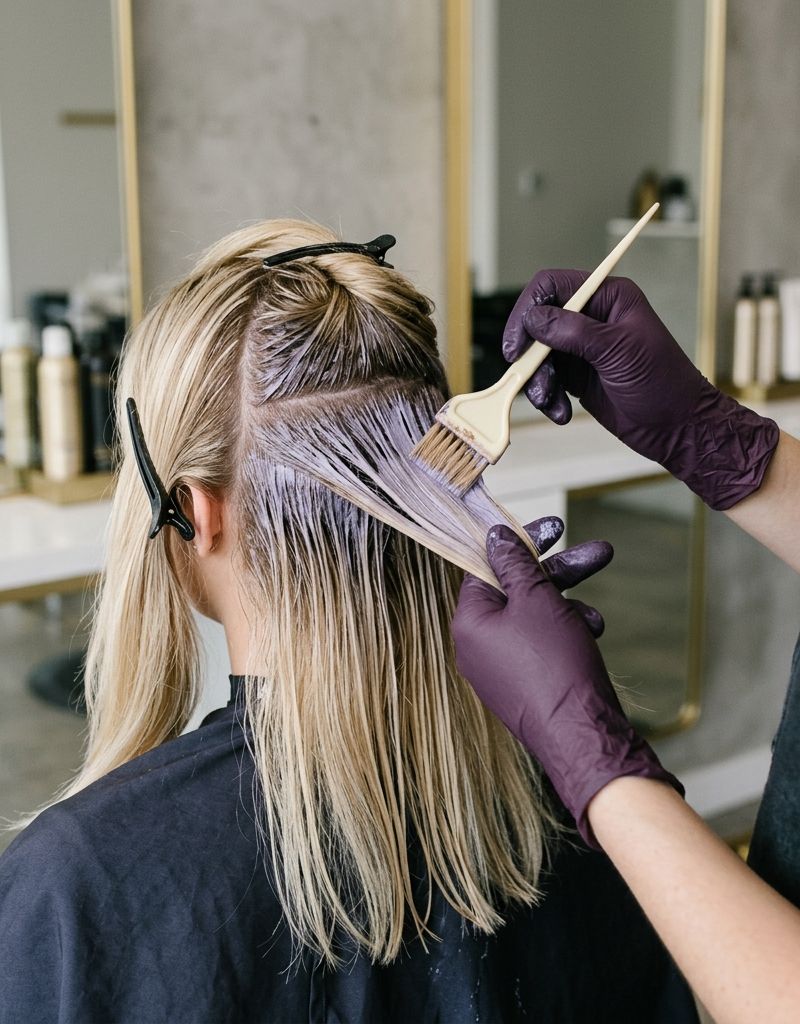
The mistake isn’t using the wrong toner. The mistake is applying any toner without having read the base first.
When a level 9 toner with a neutral-pearl reflect is applied over a base that mixes L8 in mid-lengths and L10 in roots and ends, the result is predictable but unwanted:
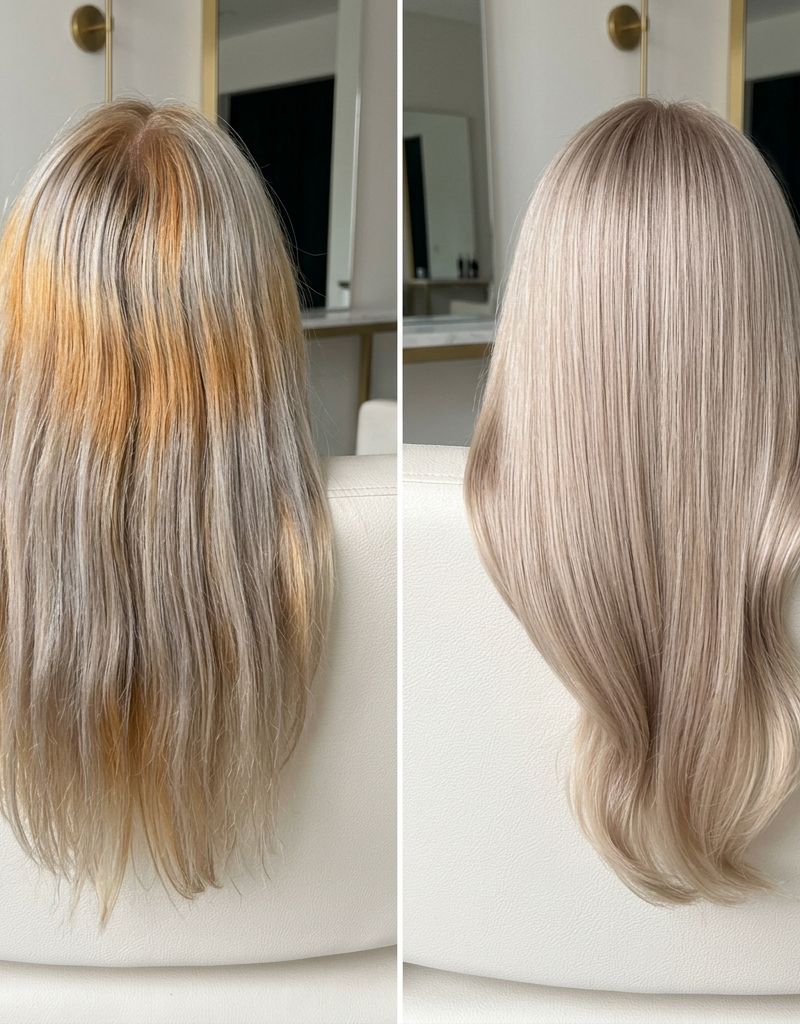
- Mid-lengths: the yellow-orange underlying pigment under the level 9 toner produces a golden or muddy result. The toner’s pigment isn’t enough to neutralise the residual warmth of an L8 base.
- Roots and ends: the very light base (L10) absorbs the same toner and can turn grey-pearl or even lilac depending on the toner’s reflect and the exposure time.
The result is exactly the patchy velvet blonde you wanted to avoid. And neither problem has anything to do with the quality of the toner.
Reading the base beforehand doesn’t add time to the service. It adds information. And that information is what turns a standard toner into an even velvet result.
What to do when the toner is already off and the result came out uneven
This happens too. You tone, you remove, and the velvet isn’t what you expected. Before starting a correction, diagnose exactly what went wrong:
-
Are there zones with visible warmth (golden, soft orange)? The base in that zone was warmer than expected. The neutralisation was insufficient for that starting point. Solution: an additional toning pass on that zone only, with more time or less dilution.
-
Are there grey zones or visible lilac reflect? The toner deposited in excess in the zones with the lighter base. Solution: a gentle lightening treatment or a more neutral, very diluted toner to bring those zones up.
-
Is the result uneven but there’s no warmth or grey problem? It may be a porosity issue: the open cuticle in some zones retains more pigment. A gloss or a targeted neutralising treatment can even the result without needing to redo the full service.
To avoid repeating the same diagnosis next time, document the zone-by-zone base you found alongside the formula you used. It’s the only way to build a record that protects you from unexpected results.
Frequently asked questions
Why does my velvet blonde come out darker in the mid-lengths than at the roots?
Almost always because the mid-lengths have a warmer underlying pigment than the roots. The toner neutralises the residual warmth at the roots (already at a pale yellow) but doesn’t reach the mid-lengths, which start from a more intense or yellow-orange yellow. Result: mid-lengths absorb more pigment and read darker or warmer.
Can I tone a velvet blonde with a very uneven base in a single session?
It depends on the degree of unevenness. If the difference between zones is half a level, differentiated toning (different timing or dilution per zone) is usually enough. If the difference is a full level or more, the most honest approach is to plan a second partial lift session before toning, or acknowledge that the velvet in this session won’t be perfectly even and let the client know before you start.
Does a high-lift toner even out the base if there’s a difference between zones?
No. High-lift shades lighten and deposit at the same time, but they don’t compensate for underlying pigment differences between zones. If mid-lengths are at L8 and roots at L10, a high-lift shade will lift mid-lengths more, but the final result will still be uneven if timing or dilution isn’t adjusted per zone.
How do I document the zone-by-zone base so I’m not starting from scratch at every appointment?
The most effective approach is to record the base found in roots, mid-lengths, and ends on the client’s record, alongside the toning strategy you used and the result. At each following appointment you can anticipate what will be different and adjust before you apply.
In summary
- Patchy velvet blonde is a base problem, not a toner problem. Roots, mid-lengths, and ends are almost never at the same underlying pigment level.
- Read the base zone by zone before deciding on a toner: roots, mid-lengths, and ends may each need a different decision.
- Differentiated toning means different timing, different dilution, or a different toner level — whatever each zone needs.
- A difference of more than one level between zones calls for a second lift session or an adjusted expectation for that service.
- Document the zone-by-zone base on the client’s record to anticipate the diagnosis at future appointments.
Calculate velvet blonde formulas adapted to each zone
Want to record the zone-by-zone base and generate the exact toning strategy for each, with every client’s history saved?
Which zone gives you the most trouble in velvet blonde services: roots, mid-lengths, or ends?
Related articles


The Blendsor newsletter
Color techniques and trends for professionals. No spam.
You know the theory. What about today's case?
Send a photo to the Blendsor advisor and get an answer grounded in colour theory: toner, developer and timing, with the brands on your shelf.
Ask about your caseWritten by the Blendsor team
Professional hair colorimetry experts with experience in AI-assisted formulation. We combine color science, salon practice and technology to help colorists formulate with precision.