Residual Pigment in Bleached Hair: Why the Same Formula Gives You Two Results
Same level 7 base, same formula, two different results. Residual pigment from an old bleach explains it: how to diagnose it and compensate with .1/.2 neutralizers.
Blendsor
Blendsor Team
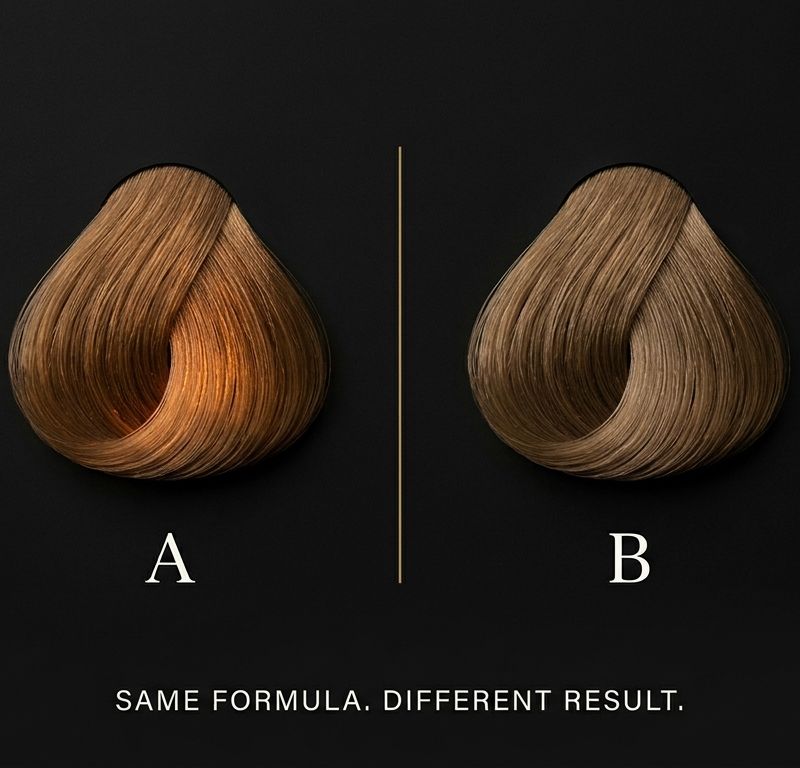
Two clients. Same level 7 base. Same formula. Same processing time. Two completely different results.
If you formulate in a salon regularly, this scenario is familiar. One walks out with exactly the reflection you targeted. The other leaves with a warm undertone nobody asked for. The key, in most of these cases, is not in the color applied. It is in what the hair already carried.
Residual pigment in previously bleached hair is one of the least documented factors in color diagnosis — and one of the most disruptive to the final result. This article explains what it is, where it lives in the fiber, why it interacts with the new formula, and how to compensate before application.
Quick summary: Residual warm pigment — fragments of pheomelanin not fully eliminated in a previous bleach service — reacts with the tonal reflection of the new formula and modifies the final result even when the base appears virgin. Accurate diagnosis plus compensation with .1/.2 neutralizers adjusted by level and estimated residue percentage corrects the deviation.
The consultation scenario: two clients, same level 7, same formula, two results
A client walks in with level 7 hair. Uniform base, no visible regrowth, no visible highlights. The consultation reveals she had “some highlights done a year and a half ago — all grown out now.” You apply the standard formula for that level. The result comes out with a coppery reflection nobody expected.
The session before: another client, same level 7, same apparently virgin reflection, zero bleach history. Same formula, perfect result.
What variable changed? Not the color. Not the developer. Not the timing. What changed was the internal state of the hair cortex. The first client had fragments of warm pigment — residual pheomelanin — still embedded in the fiber, invisible from the surface but chemically active during oxidation.
This is the most common diagnostic error with bleach-history hair: evaluating only the visible level without mapping the internal pigment that persists.
What residual pigment is and where it lives in the fiber
To understand residual pigment, it is necessary to understand what a bleach service eliminates — and what it does not.
Natural hair color is determined by two types of melanin synthesized in the follicle’s melanocytes: eumelanin (dark, brown, and black pigments) and pheomelanin (warm, red, and yellow pigments). Both are deposited in the hair cortex during the anagen growth phase, integrated into the protein structure of keratin. Pheomelanin is structurally more resistant to hydrogen peroxide than eumelanin because of its sulfur-containing (cysteine-derived) bonds, which explains its persistence in the fiber after moderate bleaching.
When a bleaching agent is applied, the peroxide oxidizes melanins through a progressive oxidation reaction. Eumelanin, being a higher molecular weight molecule, degrades first. Pheomelanin, more resistant to oxidation due to its distinct chemical structure, fragments but is not fully eliminated in moderate or single-session bleaching.
The result: low molecular weight pheomelanin fragments remain trapped in the cortex, distributed unevenly depending on the penetration depth of the original bleaching agent, the fiber’s porosity, and the original processing time.
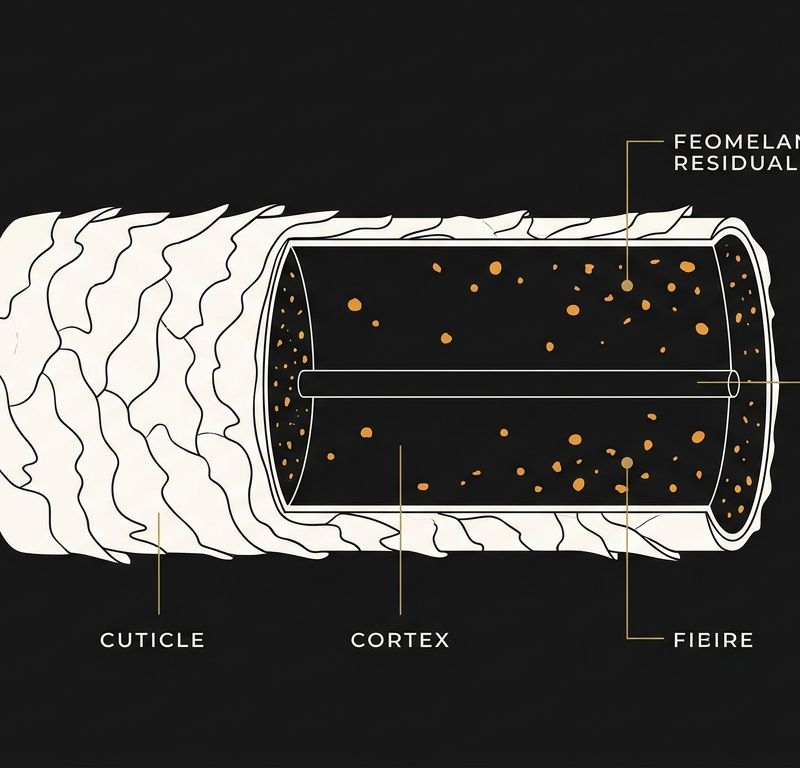
These fragments are not visible from the surface. Hair can display a clean level 7 under visual observation while internally containing residue that will become active during the next oxidation. Elevated porosity — common in previously treated hair — makes these fragments more accessible to the chemical reaction, amplifying their impact on the result.
Why the same formula produces different results
The key lies in what happens chemically when you apply an oxidative color on hair that contains residual pigment.
An oxidative tint works in two simultaneous phases: lightening existing melanin through the peroxide and developing artificial color through the oxidation of dye precursors in the presence of the same peroxide. Both reactions compete for the same oxidizing agent and occur within the same processing window.
When the hair contains residual pheomelanin, it enters the reaction as a third actor. The pheomelanin fragments, being oxidized by the peroxide, release warm undertones — orange, copper, golden yellow — that physically blend with the artificial tint reflection developing at the same time.
The visible result is an unplanned overlay of pigments: the tonal reflection you targeted plus the warm undertone the residue contributes. The intensity of the deviation depends on:
- Amount of residue present: proportional to the original bleach depth (the less hair was lightened, the more residue remains)
- Type of reflection applied: a .0 (natural) or .1/.2 (ash/cool) is more susceptible to warm contamination than a .3/.4 (golden/copper), where residue adds in the same direction
- Developer volume used: higher volume = greater activation of existing residue = greater impact on result
Professional tip: If the output reflection is coppery or warmer than expected and the developer volume was correct for the level, the first suspect is not the tint. It is the fiber’s bleach history.
In-consultation diagnosis: 3 visible signals, 1 key question and porosity test
Detecting residual pigment in consultation requires no special equipment. It requires a three-step protocol.
Visible signals
1. Warm translucency in natural light: in level 6-8 hair with residue, direct light reveals a golden-orange undertone that does not match the level perceived under artificial light. Tilt a strand toward natural light and observe the internal reflection.
2. Irregularity in level distribution: residue is rarely uniform. Hair with grown-out balayage or highlights often shows micro-variations in warmth across different sections of the shaft, visible when comparing adjacent strands.
3. Atypical response to the water test: a strand dampened with warm water for 30 seconds can reveal the hair’s real undertone. If a warmer reflection than expected appears as it partially dries, the residue is active.
The key question
Before formulating, one question changes everything: When was the last time any type of lightening service was applied, even if it has fully grown out?
The answer determines the protocol. If the history indicates lightening within the past 2-3 years and the current hair shows new growth but an apparently uniform base, residue should be assumed present in the length.
Porosity test
As detailed in the hair porosity and coloring guide, elevated porosity amplifies the effect of residual pigment: pheomelanin fragments in porous fiber react faster and with greater intensity to the developer. A basic porosity test — sliding the thumb toward the root on a dry strand — completes the diagnosis before formulating.
Formula compensation: .1/.2 neutralizer table by level and estimated residue percentage
Once residue presence is confirmed, compensation is integrated into the formula by adding cool neutralizers in proportion to the base level and estimated residue intensity.
The warm undertones of pheomelanin residue fall primarily in the orange-yellow spectrum (levels 5-8 of lightening), making the effective neutralizer blue — the .1 (ash) reflect in most brand nomenclatures — for residue in the orange-copper range. Violet (.2, iridescent) acts on the golden-yellow residue that dominates at higher levels (8-9), and an ash-violet mix (.1 + .2, written .12 or .21 depending on the brand) covers the yellow-orange middle ground. For red-orange residue at the darkest levels, a touch of matte/green (.7) added to the ash reflect cancels the red component.
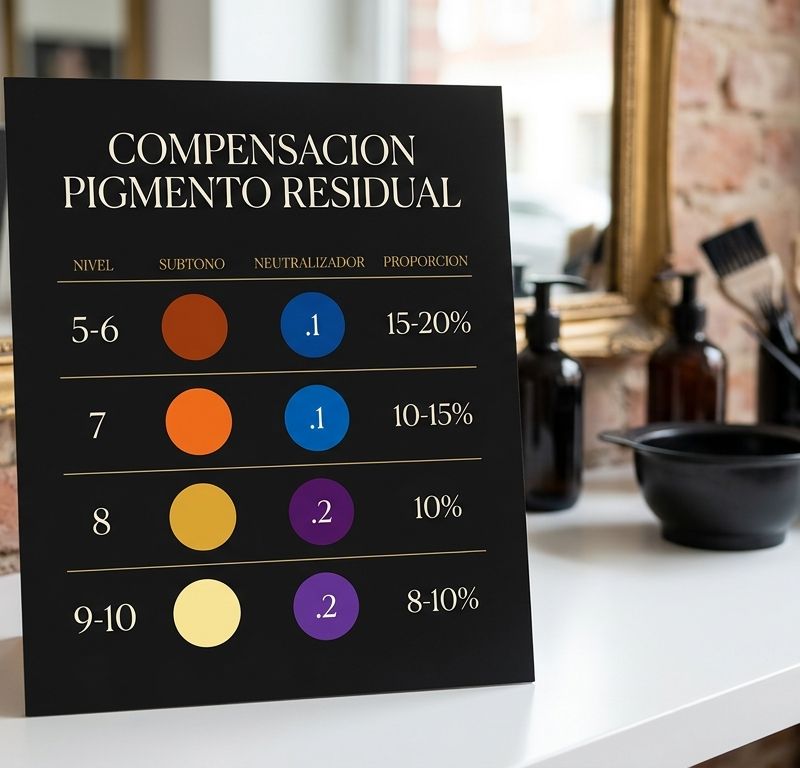
| Base level | Typical residual undertone | Neutralizer | Formula proportion | Brand reference |
|---|---|---|---|---|
| Level 5-6 | Intense orange (with red if the base was dark) | Blue: .1 intensified (.01). If red shows through, ash-matte .13 | 15-20% of total | Koleston /1 or /8 · IGORA -1 · INOA .1 |
| Level 7 | Orange | Blue: .1 (ash) | 10-15% of total | Koleston /1 · IGORA -1 · INOA .1 |
| Level 8 | Yellow (golden-copper if orange remains) | Violet: .2 (iridescent). If golden-copper, .12 | 10% of total | Koleston /6 or /1 · INOA .2 |
| Level 9-10 | Pale yellow | Violet: .2 / .21 (iridescent-ash) | 8-10% of total | Koleston /6 · INOA .2 / .21 · IGORA -12 |
Technical note: these proportions are a starting point for moderate residue (single bleach service more than 12 months ago, mostly grown out). If the bleaching was more recent or more intensive, residue may be lower; if it was very superficial (partial lifting), it may be more intense. The exact calculation per case — integrating level, porosity, elapsed time, and original bleach depth — requires crossing all variables simultaneously, something that 30V and the variables that depress lift also addresses from the developer angle.
Common salon cases: old balayage, 2018-2020 ombré and single bleach service over a year ago
Three profiles account for the majority of active residual pigment cases in consultation.
Old balayage (12-24 months)
This is the most common case and the one that creates the most confusion. The original balayage has grown out, new regrowth has visually covered the previous work, and the current level appears uniform. However, the areas that received lightening — typically mid-lengths and ends — still contain residue, especially if the balayage was taken to a moderate level (6-8) rather than very high levels.
The typical deviation: when applying a full-length color treatment or maintenance tint, mid-lengths and ends come out warmer than the root. Residue in those areas adds warmth to the applied reflection.
Protocol: identify zones with bleach history through visual inspection under natural light and apply selective compensation in those areas only, not throughout the full length.
2018-2020 ombré (the “grown-out trend” generation)
The era of defined ombré left a legacy of hair with a bleach gradient from mid-length to ends. Many clients who came to the salon during those years now carry that history in their length, even if the current look is completely different. Residual pigment in those ends can persist for years if no subsequent bleach service or cut has eliminated it.
Warning signal: ends that consistently come out warmer than mid-lengths and roots in any color work, regardless of the reflection applied.
Single bleach service over a year ago
The quietest case. A client who had a one-time bleach — for a special occasion, a lived color experience — over 12 months ago and has been growing it out since. The new root has no residue. The lightened length does. If the cut has not eliminated that entire section, the formula will encounter two substrates with very different behavior.
Common mistakes when residue goes undetected and how to rescue an already-applied result
The three most frequent errors
Error 1: Increasing developer volume. When a result comes out warmer than expected, the instinctive reaction is to assume insufficient lift power. Using a higher developer in the next service will only activate the existing residue more, worsening the warm deviation.
Error 2: Changing the reflection without compensating for the residue. Switching from a .3 to a .0 or .1 without prior neutralization produces even more unpredictable results, because the new cool reflection reacts with the warm residue in a more visible way (greater temperature contrast).
Error 3: Repeating the “formula that worked before”. If a formula worked 18 months ago when the hair was freshly grown from the bleach service, the residue situation was different at that time. Over time, residue distribution changes with each subsequent service and growth cycle.
How to rescue an already-applied result
If the result is already in and the warm deviation is visible, the options are:
-
Immediate neutralizing toner: apply a no-lift, water-based toner (gloss, demi-permanent) with a cool reflection directly opposing the emerged undertone. Reduced timing (10-15 minutes). No aggressive developer.
-
Wait for the next service with planned compensation: if the deviation is mild and the client can manage with it, document the complete history and formulate with compensation at the next service. Forced immediate neutralization on porous hair can overcompensate.
-
Direct neutralizer toning (semi-permanent): for moderate deviation at higher levels (8-9), a semi-permanent with violet or blue pigment applied on damp hair can balance the undertone without compromising fiber structure.
Warning: attempting to neutralize a very warm result with a second oxidative color application the same day means peroxide accumulation in already-treated fiber. In hair with high porosity, the risk of structural damage outweighs the cosmetic benefit.
Frequently asked questions about residual pigment in previously bleached hair
How long does residual pigment from bleaching last?
Residual pigment does not disappear spontaneously over time. It is eliminated through new bleaching processes, oxidative services that progressively degrade it, or simply by cutting away the hair that contains it. In hair without new services, residue remains chemically active for years.
Does level 7 hair with bleach history always have residual pigment?
It depends on the depth and number of original bleach sessions. A bleach service that took hair to level 9-10 will have eliminated more pheomelanin than one that reached level 7-8. The less the hair was lightened, the more potential residual pigment exists. Visual diagnosis under natural light and precise consultation history are the only reliable indicators.
Do conditioning treatments between sessions affect residual pigment?
Maintenance treatments (moisturizing, protein, keratin) do not significantly eliminate or reactivate residual pigment. They do not alter the chemistry of fragmented melanins in the cortex. The only real impact is on porosity: well-conditioned, less porous hair may show slightly more controlled residue reactivation in the next oxidative service.
Is the behavior of residual pigment different with powder vs. cream bleach?
Yes, with nuance. Powder bleaches with persulfates typically produce more aggressive and faster lifting than cream formulas, which can eliminate more pheomelanin in a single session. However, cortex penetration also depends on the specific formulation, the developer used, and the fiber’s initial condition. The residue outcome varies case by case.
How can I neutralize orange undertone in previously bleached hair without damaging the fiber?
The neutralizing unwanted hair tones article details the complete protocol by undertone and level. For previously bleached hair with high porosity, the key is using the neutralizer with the gentlest developer possible (6-10V) in a demi-permanent or gloss format, which works on the surface cortex without aggressive oxidation.
What is the difference between residual pigment and the underlying pigment that appears when lightening?
Underlying pigment is the warmth that a lift reveals in the moment: it belongs to the natural melanin of the hair and it appears in a predictable sequence by level (red-orange at 5-6, orange at 7, golden-yellow at 8-9). Residual pigment is what a previous bleach service left behind: pheomelanin fragments already broken down but never washed out of the cortex. The practical difference is timing — underlying pigment shows up while the peroxide is working and can be anticipated from the target level, whereas residue is already there before you mix anything and does not follow the level chart. That is why a base that looks like a clean level 7 can still behave like a level 6 with warmth to spare.
Does a colour remover or a bleach wash eliminate residual pigment?
A colour remover does not. Removers shrink artificial dye molecules so they can be rinsed out; they act on oxidative tint, not on melanin, so residual pheomelanin stays in the cortex untouched. A bleach wash (bleach diluted with shampoo) does act on melanin and will degrade part of the residue, but it lifts unevenly and adds porosity, which amplifies the reactivity of whatever residue survives. If the aim is to clear residue before a cool target, a controlled lightening service with a measured developer is more predictable than a bleach wash — and in most cases, compensating in the formula is the lower-risk route.
In summary
- Residual warm pigment consists of pheomelanin fragments not eliminated in a previous bleach service that remain in the hair cortex.
- They are invisible to external observation but react actively during the next oxidation, adding warm undertones to the result.
- Diagnosis combines precise consultation (bleach history), visual inspection under natural light, and a porosity test.
- Compensation involves integrating cool neutralizers (.1 ash/blue against orange, .2 violet against yellow, .7 matte/green against red) in proportions adjusted by base level and residue estimation.
- The most frequent cases involve grown-out balayage, older-generation ombré, and single bleach services over 12 months ago.
The same formula can produce two different results. Not because the formula is wrong. But because the two hairs are not the same on the inside.
Formulate with complete information. Blendsor integrates bleach history, porosity, and current level into the compensation calculation.
Related articles

Practice with our colorimetry tools
Calculators, neutralization wheel, AI consultation...
The Blendsor newsletter
Color techniques and trends for professionals. No spam.
You know the theory. What about today's case?
Send a photo to the Blendsor advisor and get an answer grounded in colour theory: toner, developer and timing, with the brands on your shelf.
Ask about your caseWritten by the Blendsor team
Professional hair colorimetry experts with experience in AI-assisted formulation. We combine color science, salon practice and technology to help colorists formulate with precision.