Dark Cherry: The Level Gets Decided by the Light, Not the Photo
Dark cherry at level 2 reads black indoors. How to choose between level 2, 3, and 4 based on where a client actually lives, what to ask first, and the cost to undo it.
Blendsor
Blendsor Team
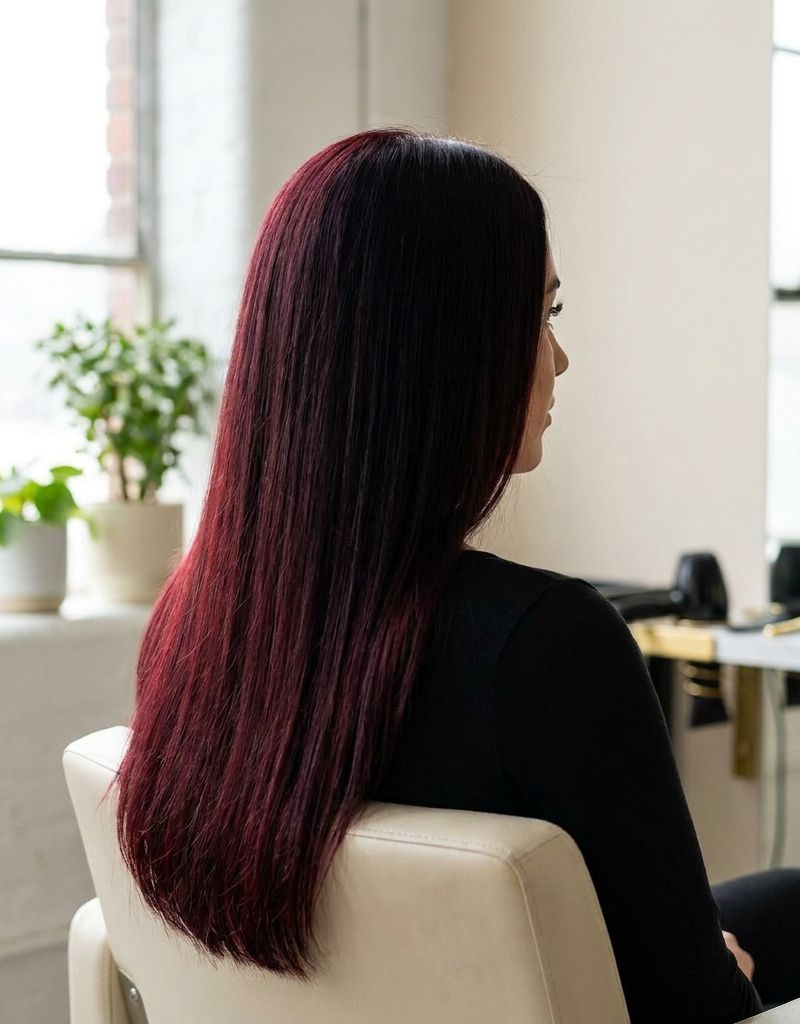
She pulls up a saved photo on her phone: hair that reads almost black, and when she turns her head, it throws a deep wine red. That’s what she wants.
If you formulate for a living, you already know that photo isn’t a formula. It’s a shot taken in full sun. And the call you’re about to make in the next ten minutes — level 2, 3, or 4 — isn’t decided by the photo. It’s decided by the light this client is going to live in for the next four months.
This one’s about that call, and what it costs to walk back.
What level should you formulate for dark cherry?
It depends on where the color is going to be seen. The lower the level, the less light the hair reflects back — and a reflect only shows up if there’s light bouncing off it. That’s why the same cherry behaves differently depending on where someone spends their day: at level 2, the red needs strong, direct light to surface; move up to 3 and 4 and it shows with less light, at the cost of that “almost black” depth that’s usually what sold the photo in the first place. This isn’t a measured scale off anyone’s swatch book — it’s just the framework that keeps the consultation on track.
Translate that to the chair: if she works in an office under fluorescents, or lives somewhere with six months of gray sky, level 2 is going to give her a black with a wink almost nobody will ever catch. That reference photo was shot in direct sun.
| Level | How it reads | Who it’s for |
|---|---|---|
| 2 | Black indoors, cherry only in direct sun | Wants maximum depth and is fine with the red being a secret |
| 3 | The reflect shows up in window light | The most-requested middle ground |
| 4 | Cherry visible almost all the time, less depth | Wants the color seen, not implied |
The table organizes the conversation — it doesn’t measure anything. Salon lighting, office lighting, and a street in August aren’t comparable, and the same level 3 won’t read the same in Seattle as it does in Phoenix.
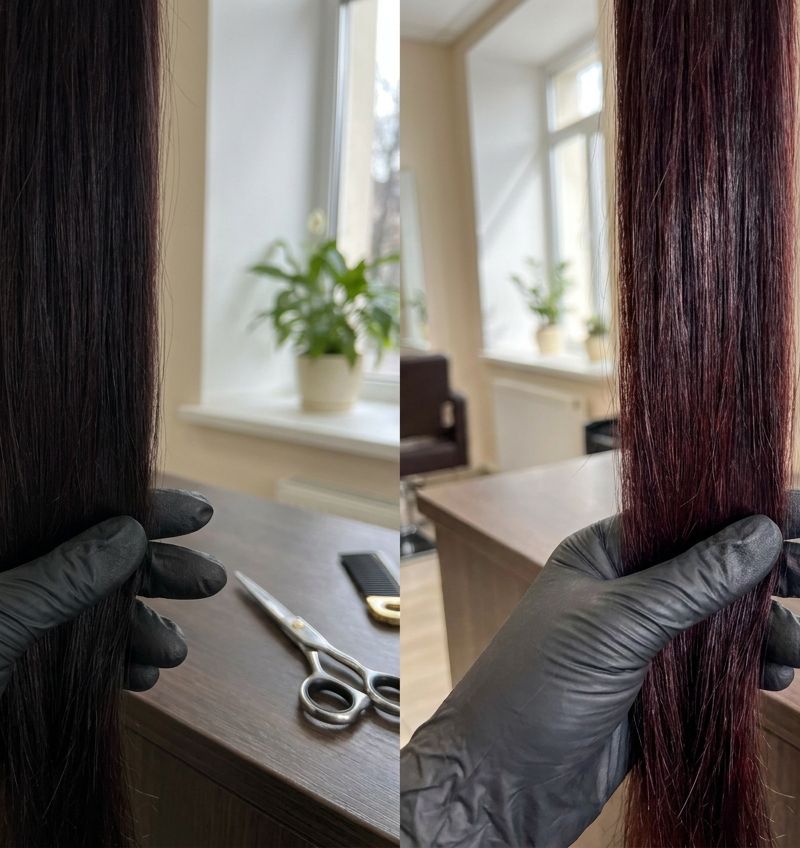
Same hair, two lights. On the left is what she’ll see at her desk.
A note on shade codes: every brand numbers its reflects differently, so what we’re talking about here is a family — red with violet support — and you’ll pull the exact code from your own line’s chart. The same digit means different things across manufacturers.
What to ask before you crack the tube
Before you even get to level, there’s a question you can’t skip: has she used henna, a vegetable-based color, or anything that “wasn’t dye”? If the answer is yes or she’s not sure, nothing goes on top without an incompatibility test first. Cut a strand, take it off the head, and submerge it — in a non-metallic bowl — in about 20 ml of 20-volume peroxide with 1 ml of ammonia. The ammonia isn’t optional: skip it and the reaction may never kick in, handing you a false negative. Let it sit 30 minutes and watch it.
Stop the service if the strand heats up, bubbles, smokes, smells off, or breaks down. And don’t call it clear too fast: a strand that lightens instantly, or one that shows zero reaction after those 30 minutes, isn’t good news either — those are the other two ways metallic salts show up, and neither of them bubbles. The only negative that clears you to proceed is a strand that lightens very slightly with no physical reaction at all.
The fine chemistry: pure henna’s lawsone doesn’t react, but the metallic salts in compound hennas do. Since you almost never get a straight answer at the chair about which one she actually used, the test is the instruction, not her word. This is the one step in this whole piece with real risk of physical damage.
Next, the patch test. Run it 48 hours before every single application — including on someone who’s colored for years without a problem. Sensitization shows up exactly there, in the long clean history. “PPD-free” lines don’t get you off the hook; they carry other bases that cross-react.
And then the conversation that actually changes the service. It’s not a disclaimer — it’s diagnosis:
Questions that actually earn their keep at the chair
— “Where do you spend most of your day — natural light or artificial?” (decides the level) — “What are you picturing for spring?” (decides if this is an exit door or an entry point) — “Have you used henna, any plant-based color, or something that ‘wasn’t dye’?” (decides if there’s a service at all) — “When was your last color, and what did they use?” (decides the entry path)
That last question is the one people skip most, and it’s the one that everything else hangs on.
What’s already sitting in the hair decides the entry path
Here’s the most expensive reasoning error: asking yourself “do I need to pre-lighten?” For a dark target, there’s nothing to lighten. You’re depositing color, and deposit means zero levels of lift — whatever developer your line calls for to work at the same level or darker (3% / 10 volume for IGORA Royal, 4% for Welloxon Perfect), or a straight tone-on-tone formula if there’s no gray to cover.
The right question is different: what’s actually occupying that fiber right now?
- Virgin hair. Direct deposit. The clean scenario.
- Previously colored hair, same level or lighter than the target. Also direct deposit — nothing to remove first.
- Previously colored hair that’s darker, or carrying years of built-up reflect. This needs extraction before anything goes on, and that’s its own service with its own ceiling: Schwarzkopf’s technical manual for their color extractor — a product mixed with developer, not a pure reductive stripper — caps it at three levels, and past that it defers to classic bleach. That’s the manufacturer’s line, not a style call.
- Bleached, porous hair. Not direct deposit. It’ll grab pigment unevenly and shift tone; it needs pre-pigmentation first, or there’s nothing for the color to hold onto.
The extraction work itself isn’t rehashed here — it’s already written up in more depth than fits in this section: the difference between an extractor and a gentle decolor, with the table for which tool fits which situation, lives in correcting dark buildup in mid-lengths and ends. If what’s in front of you is a full-blown correction, the complete protocol is in professional color correction.
The cost of walking it back, in one sentence
Say this out loud before you apply: a dark cherry goes on in one session and comes off over several. The lower the level and the more years of reflect stacked underneath, the longer the walk-back. And there’s a curveball that surprises even your most experienced regulars: weeks after the color’s been removed, the tone can come back. Why that happens and how to get ahead of it is covered in why color comes back after color remover.
Saying it up front turns a future complaint into a decision she made with you today.
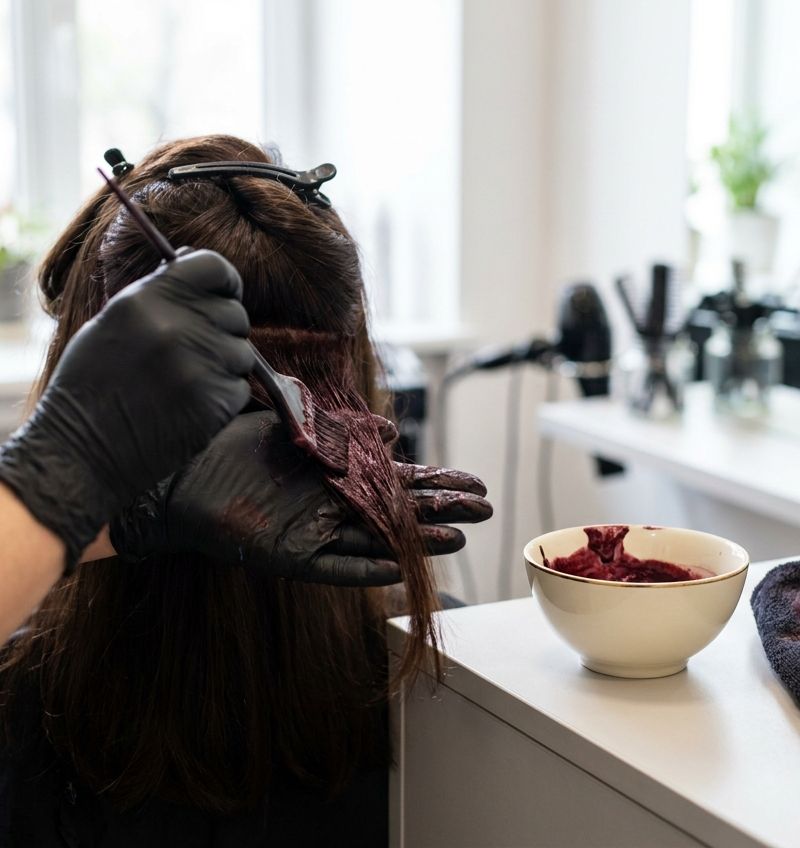
What’s in the bowl tells you more about the outcome than the reference photo does.
Gray coverage: this is where you decide the developer, not the level
A trend reflect doesn’t cover gray. What covers gray is the natural base underneath it — and that’s the entire difference between a dark cherry with gray handled properly and one that shows white roots three weeks later.
Which brings up the one apparent contradiction in this piece — worth spelling out plainly:
- No gray: tone-on-tone with whatever developer your line calls for to work at the same level or darker. You’re depositing, not lifting.
- With gray: permanent color with whatever developer your line specifies for gray coverage — and that number comes off your own chart, not a general rule. For Koleston Perfect, Wella ties 6% (20 volume) to gray coverage; for IGORA Royal, the developer chart gives gray coverage at 6% (20 volume) and also at 3% (10 volume) when you’re going darker at the same time — which is exactly what’s happening here. Check your own chart before you assume 20 volume is automatic.
You’re not picking the volume to change the level — it’s there so the color molecule forms properly inside the fiber and the gray actually gets covered. That 20 volume also happens to lift around one level is a side effect that doesn’t get in the way on a dark target, not the reason you reached for it.
And natural always goes into the mix. The reflect only supplies the tone; the base is what does the covering.
The 48-hour letdown
She leaves the chair looking incredible. Two days later, she texts you: “it went black.”
The color didn’t fade — the reflect just stopped reading. At level 2-3, the margin between “deep cherry” and “flat black” is razor thin, and red is the first thing to drop out of it. Part of this comes down to how the service was closed: if oxidation residue is still sitting in the fiber, the color keeps shifting after she walks out the door. That’s why Wella doesn’t call the Koleston Perfect protocol done at rinse — it calls for neutralizing that residue and stabilizing the color before you finish.
What you can actually control before it happens:
- Emulsify and rinse until the water genuinely runs clear. Leftover product in the fiber keeps working.
- Close with a real acid at the end of the service. Keratin’s isoelectric point sits around pH 3.67 — that’s where the fiber swells least and the cuticle lies flattest, which is why post-service seals are formulated in the 3.5 to 4.5 range: not higher, where it stops contracting, and not lower, where the fiber swells back up. A regular conditioner sits above that range and doesn’t do this job. That settled cuticle is what holds the reflect in place.
- Warn her about staining. Cherry is one of the tones most likely to mark pillowcases and collars the first few nights.
If it’s already happened: over mid-lengths already saturated at level 2, pushing back in that same day is the call most colorists regret afterward. Some extractors are rated for a second pass and their spec sheet says so — but what actually decides isn’t the product’s ceiling, it’s the state of the fiber in front of you. Check that before you touch anything: porosity outranks the urge to fix it today. In a lot of cases the honest answer is a few washes and a rebooked reflect at the next visit, not another pass on hair that’s already been through enough.
Why red shows wear before any other tone, and how to formulate it to hold longer, is covered in long-lasting red formulas.
Frequently asked questions
What level is dark cherry?
There isn’t one — it’s worked between level 2 and 4. Level 2 gives you a black that only lets the red out in direct sun; level 3 is the most-requested balance; level 4 shows the cherry almost all the time in exchange for less depth. The choice comes down to where a client actually spends her day, not the reference photo.
Do you need to bleach before doing a dark cherry?
No. It’s a dark target: you’re depositing color, and deposit means zero levels of lift. The only prep work needed is when the base is darker than the target or carries built-up reflect — and that’s pigment extraction, not lightening to “open a path.”
How long does dark cherry hold before the reflect fades?
The dark base holds, but the red reflect loses intensity before anything else does, and it needs refreshing between visits. Timing isn’t set by the technique or the calendar — it’s set by the contrast between the new growth and the colored mid-lengths, plus that fiber’s porosity. On a cherry over a dark base, that contrast takes a while to show, so root visits get scheduled by what you actually see. What you can plan for is the order: the reflect asks for a maintenance gloss before the roots ask for full color.
Can you remove dark cherry to go blonde?
Not in one session, and you should say so before you ever apply the color. The artificial pigment has to come out first, then you work the level, capped by whatever your extractor’s spec sheet says: Schwarzkopf’s manual sets it at three levels, and past that it’s classic bleach. Check your own product before promising anything — a pure reductive stripper and an extractor mixed with developer aren’t measured by the same yardstick. It’s a multi-visit plan, not a service.
The short version
- Light decides the level: at level 2, cherry only shows in direct sun; indoors it reads black.
- The question isn’t whether to pre-lighten — going dark means depositing, zero levels of lift — it’s what’s already sitting in the fiber.
- Henna or metallic salts stop the service, and the patch test runs 48 hours before every application, even on longtime regulars.
- Gray decides the developer, not the level: tone-on-tone with no gray, permanent with coverage strength when there is.
- The cost to undo it gets said out loud before you apply, not after the complaint comes in.
Calculate professional formulas with AI
Want to calculate the full formula for a dark cherry based on a client’s starting level and chemical history?
Related articles



Practice with our colorimetry tools
Calculators, neutralization wheel, AI consultation...
The Blendsor newsletter
Color techniques and trends for professionals. No spam.
A client in the chair right now?
The Blendsor advisor gives you the precise formula for this technique with your salon's brands — and saves it to your client's card.
Ask about your caseWritten by the Blendsor team
Professional hair colorimetry experts with experience in AI-assisted formulation. We combine color science, salon practice and technology to help colorists formulate with precision.