What to Tell Your Colorist Before Coloring Your Hair
Your colorist doesn't need a shade name, they need your history. What to mention before you color, in what order, and why it decides what's possible.
Blendsor
Blendsor Team
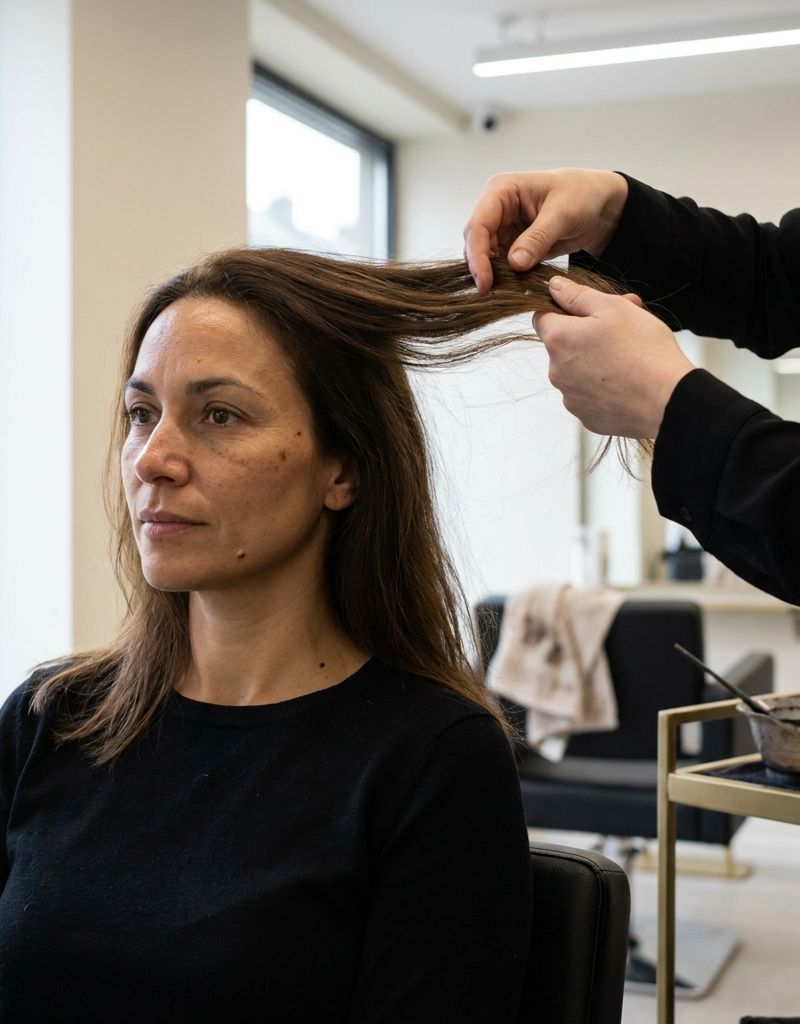
Your colorist doesn’t need the name of a shade. They need to know what’s already on your hair: whether any dye ever gave you itching or a welt, whether you’ve ever worn henna or a plant-based color, any relaxer or keratin treatment even if it wasn’t a dye, your color history with dates, and what you use at home. With that on the table, they can tell you what’s achievable today.
Quick summary: the reference photo says where you want to end up. Your history says where you’re starting from — and the second one outranks the first. This article puts the conversation in order of consequence: safety first, then chemistry, then shade.
How many times have you walked into a salon with a photo on your phone and walked out with a color that wasn’t quite it?
It usually wasn’t the photo’s fault. And it usually wasn’t the fault of whoever did your hair.
What actually decides how far your color can go today isn’t the shade you ask for. It’s what your hair is already carrying — and at the start of the appointment, you’re the only person who knows.
Here’s what to say, in what order, and why each piece changes the outcome.
What does your colorist need to know before touching your hair?
They need your chemical history in this order: whether any dye ever caused itching, a welt or swelling; whether you’ve ever used henna or a plant-based color; any relaxer, perm or keratin treatment even if it wasn’t a dye; the colors and lighteners you’ve had, with rough dates; and what you use at home. That order isn’t arbitrary — it runs from what affects your health to what only affects your tone.
| What to mention | Why it matters | How far back |
|---|---|---|
| A previous reaction to dye | Safety. It can rule the service out | Always, no time limit |
| Henna or plant-based color | Can make any lightening unpredictable | Always, even years ago |
| Relaxer, perm or keratin | Changes how color enters and how long it lasts | Anything still in the hair you haven’t cut |
| Dyes and lighteners | Sets the real starting point | Anything still in the hair you haven’t cut, with dates |
| What you use at home | Explains odd tones and uneven porosity | Whatever you use now |
That “still in the hair you haven’t cut” is more literal than it sounds. Hair grows around a centimetre a month: if you’ve had mid-length hair uncut for two years, what went on it two years ago is still sitting in your ends. So more than a number of months, what really places your history is when you last had a cut and how much came off.
Notice something: not once in that table does a shade name appear. That part comes later — and not because it’s the lesser half, but because until everything above is settled, nobody knows which of those shades your hair can actually reach.
First of all: if a dye ever made you itch or break out
This comes before anything else — before you even open the photo.
If you ever noticed scalp itching after coloring, a welt on your neck or around your ears, swelling on your face or eyelids, or just something that didn’t feel right — say so. Even if it was ten years ago. Even if it cleared up on its own. Even if you assumed it was the heat of the dryer.
Oxidative hair color contains substances that can sensitize you over time, and a reaction can build with repeated exposure rather than showing up the first time. The FDA’s guidance on hair dyes is direct about it: manufacturers instruct a patch test before each application, and a previous reaction is a reason to stop, not a footnote.
What happens when you mention it: the likely outcome is that the colour doesn’t happen that same day. Depending on what you describe, you’ll be offered a sensitivity test 48 hours ahead, or — if the reaction you describe was severe, with swelling of the face or eyelids — asked to check with your doctor or an allergist first. That isn’t an excuse not to take you: repeating a patch at home on already sensitised skin can trigger a worse reaction than the first. Mention it when you book, not once you’re in the chair.
And this is the part people find surprising: an allergic reaction doesn’t have to show up the first time. You can color your hair twenty times without incident and react on the twenty-first. “I’ve been coloring for years” isn’t a reason to skip this.
There’s also one route almost nobody connects with colouring: temporary black henna tattoos, the kind done on holiday that last a couple of weeks. The mandatory warning on the box names them specifically — they can raise your risk of an allergy, and having reacted to one is a reason not to colour. If you’ve had one, mention it even if it was years ago and even if nothing happened at the time.
Henna and plant-based color: the detail that changes the most
This is the one almost nobody brings up, and the one with the biggest consequences.
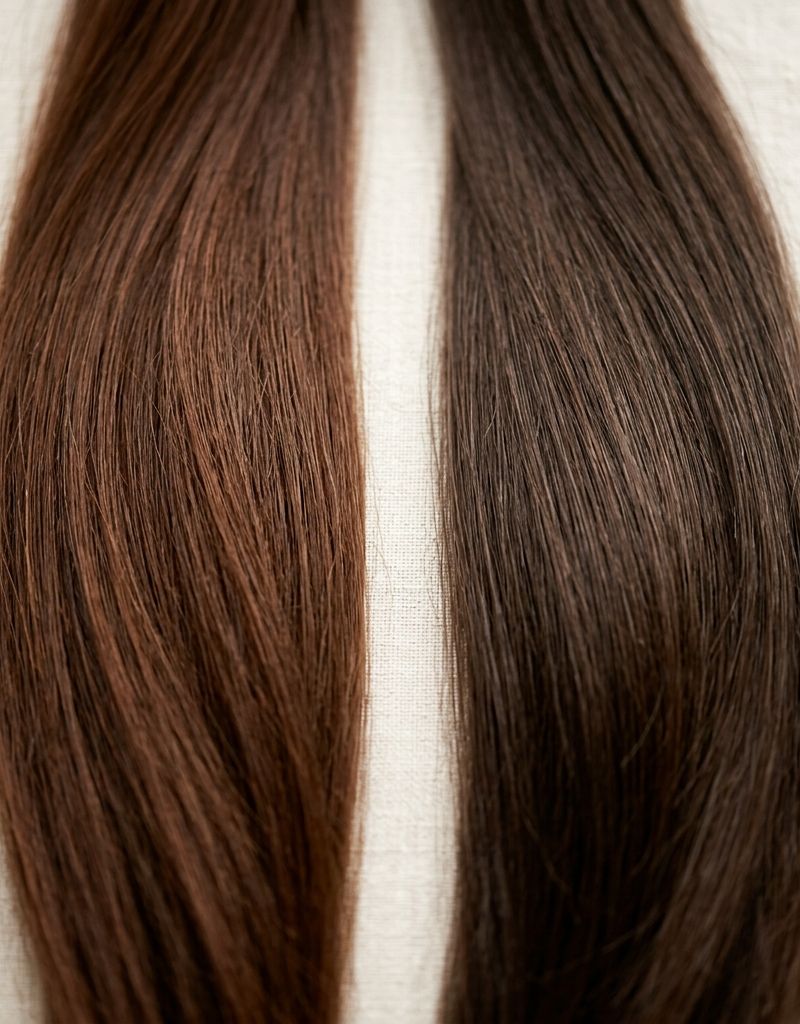
There’s one practical rule: nobody lightens or bleaches over henna without running the cut-strand test first. The chemistry explains why the rule allows no shortcuts. Pure henna on its own doesn’t cause the dangerous reaction — metallic salts do. But it isn’t neutral either: henna grips the fibre and coats it, so lightening over the top tends to lift unevenly and pull oranges that are hard to correct. And there’s an added problem: many products sold as henna aren’t henna alone. They carry added metallic salts to fix or shift the color, and those salts do react with the peroxide used for lightening. In the salon you can almost never confirm which of the two you had, which is why the decision isn’t made by asking — it’s made with the strand.
When that happens, the mixture can heat up abnormally on your head, lightening comes out patchy, and the hair can end up with a gummy texture. The technical side of this is in metals in hair during bleaching.
Three clarifications that prevent misunderstandings:
- “It was years ago” doesn’t cancel it out. Henna deposits into the fiber and leaves with the hair you cut, not with the hair you wash. If your lengths are three years old, so is the henna in them.
- “It was natural” doesn’t mean “it doesn’t count”. A product sold as natural is no guarantee it was plant only, and the label doesn’t always make that clear. If you can’t be sure what was in it, mention it anyway.
- Nobody can spot it by looking. What gets done instead is a strand test: a small section is cut and the planned mixture applied to it, off your head. The first ten minutes already tell you whether there’s a reaction — abnormal heat, greenish tones, bubbling. Finding out how far it lifts, and whether it lifts evenly, takes the product’s full processing time. It can be done the day before in a short visit, which is why the colour normally won’t happen that same afternoon. That wait is the difference between a normal service and a rescue.
Everything you put on to straighten it, even if it wasn’t color
Here’s the other blind spot. Plenty of people understand that dye needs declaring, and it never occurs to them that a straightening treatment counts too. It counts, and it counts a lot.
A chemical relaxer, a perm or a keratin treatment isn’t done to change your colour, but it does change the fiber the colour has to travel through — and some of them also lift the natural pigment a little or fade the dye you were already wearing. After a process like that, porosity tends to be left high and uneven: some sections drink up pigment, others barely take it. The usual result is color that lands patchy and fades sooner than expected.
Mention it even if:
- It was “just something for frizz”
- You did it at home
- The straightening effect has long worn off
- It was more than a year ago
You may be asked which one specifically, and it’s worth answering with the name if you remember it: a relaxer that breaks internal bonds isn’t the same as a treatment that seals the surface. Both change the result, but differently and with different margins.
Your color history, with dates and in order
Now for the color history itself. And here the sequence matters as much as the content.
“I’ve dyed it brown” isn’t the useful version. The useful version is the order: what went on, when, and what happened next. Hair that was lightened eight months ago and then darkened twice is not in the same place as hair carrying a single brown from eight months ago — even if both look equally brown in the mirror today.
That detail isn’t cosmetic. Two people sit down with the same brown in the mirror. One says “just a brown in March”. The other says “I lightened in November and then went darker twice”. From that second sentence on, what was planned as one session starts being discussed as two, with a strand test in between. The hair you can see hasn’t changed: what’s known about it has.
What genuinely helps:
- Rough dates (“March”, “before the summer”) — nobody needs the exact day
- Salon or at home, and if at home, the brand if you remember it
- Any lightening at any point, even if it was only highlights or the ends
- Anything that went wrong and was corrected — a correction leaves its own trace
- Any time you went darker after having been lighter
At-home color deserves its own note, and not out of snobbery: the point is that the full formula and how much built up with each pass are facts only you have. If you want the full comparison, it’s in at-home hair dye vs the salon.
What you use at home every day
This is the part that sounds least important and explains a surprising number of surprises.
A color-depositing shampoo, a purple or blue toning wash, a pigmented mask, something that “wakes up copper” — they all deposit. A little each time, but across several washes it adds up. When someone looks at your hair to decide a formula, they’re reading the color they can see, and if that color has a recent deposit sitting on it, what they’re reading isn’t your real base.
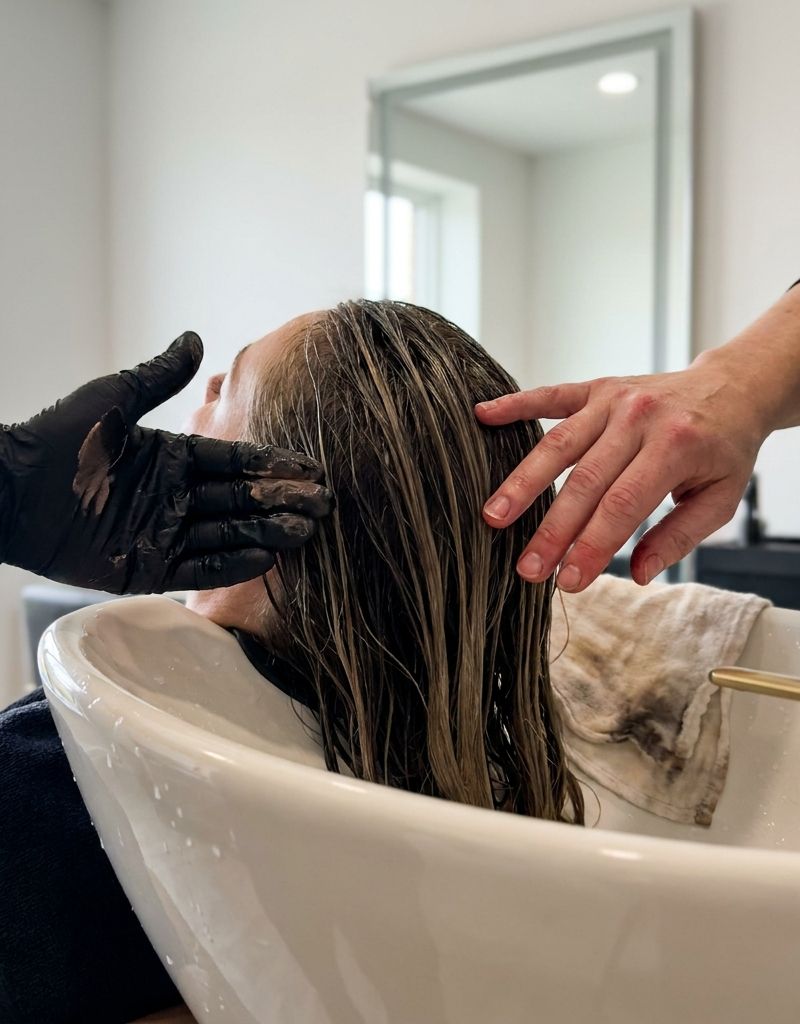
Just saying what you use and how often is enough. And if you have an appointment coming up and you use a toning product, asking how many days beforehand to stop is a good question that almost nobody asks.
Why the reference photo isn’t enough on its own
To be clear: bringing a photo is a good thing. It’s the fastest way to communicate a taste, and no verbal description conveys a tone the way an image does.
The photo isn’t the problem. Asking with only the photo is.
When you walk in saying “I want this shade”, you’ve skipped a step: you’ve chosen the solution before describing the problem. And the person in front of you is left without the information they’d need to tell you whether that solution fits your hair, in how many sessions, and with what upkeep.
Change the sentence and you change the conversation:
| Instead of | Try |
|---|---|
| ”I want this blonde" | "I like this blonde; here’s what I’ve got on" |
| "A shade lighter" | "I want more brightness — how far can we go today?" |
| "Get the orange out" | "It went orange after this; what are my options?” |
There’s another reason a photo alone misleads, and it’s a different one: the same shade reads differently against your skin and your natural contrast. We handle that separately in what hair color suits you. Here the argument isn’t your skin — it’s your chemistry.
How to show up with your history ready in five minutes
You don’t need a dossier. This is more than enough:
- Think backwards from today: what’s the last thing that went on your hair, and when?
- Check your phone: dated photos are the best color record there is. Scrolling your last year of pictures settles most of the dates.

- Look under the sink: the bottles you’re using now, by name.
- Recall any discomfort, however small, after a color service.
- Note the odd stuff: “it went green in summer”, “the ends won’t hold color”. Symptoms are data.
- Go back over your last year of health, not just your hair: any recent medical treatment or medication — chemotherapy, isotretinoin for acne, thyroid, anaemia, a postpartum period — changes the fibre and sometimes the scalp itself. It isn’t nosiness: there are cases where waiting is the sensible call.
- Account for the summer: pool, sea, or very hard tap water. Chlorine and copper from water deposit in the hair and react with lightening the same way the metallic salts above do. It’s where a lot of August greens come from, and only you know how many times you got in.
If you’ve been going to the same place for years, some of this is already in your file. That’s exactly the value of someone recording what they do to your hair: next time doesn’t start from zero. And if you switch salons, carrying that information with you is what saves you from walking the same road twice.
Frequently asked questions
What if I can’t remember what’s on my hair?
Say exactly that, and say it when you book rather than once you’re in the chair: “I’m not certain, I think it was a brown in the spring.” An honest “I don’t know” is useful information — brown means there’s deposit, spring means it’s sitting in your mid-lengths and ends; a made-up detail isn’t. When there’s doubt, the move is a strand test, which shows how your hair actually behaves without committing your whole head. Said over the phone or by message, that test fits into the diary. Said with two hours already booked for something else, it rarely does, and you end up coming back another day anyway.
Why do they ask about henna when I only wanted a shade change?
Because nobody knows upfront whether the shade change will need even a little lightening, and that’s where henna carrying metallic salts can react. It’s a routine question, the way a dentist asks what medication you’re on: everyone gets asked, and most of the time the answer is no.
Does a keratin treatment count as a chemical process?
Yes, as far as the consultation goes. Even though it doesn’t change your color, it changes the state of the fiber and with it how pigment enters and how long it holds. Mention it with the rest of your history.
Do I need a patch test every single time?
The manufacturer says it plainly on the box: a sensitivity test 48 hours before every application, not just before the first one. That’s the instruction, and it’s the one that counts if anything ever goes wrong.
They may not repeat it at every root touch-up. If you want it done, ask: that isn’t you being fussy, it’s what the product they’re about to put on you says.
And there are three situations where skipping it has no defence: before your first ever colour, whenever the brand or line changes, and any time you’ve noticed a previous reaction, however small. The reason is the one above — an allergy can appear out of nowhere even after years with the same product.
If they offer it, it isn’t red tape.
Can I ask them to write down the formula they used?
You can ask for it to be recorded, and it’s a reasonable request: the file is what lets you repeat a colour you loved, or change course if you didn’t, instead of reconstructing it from memory. Asking for the written formula to take away is a different thing: that’s each salon’s call, because a formula is part of their work, and some won’t share it. What you can always take with you: the date, whether there was any lightening, which brand was used, how many sessions it took and how your hair responded. With that, whoever takes you next time isn’t starting from zero.
The short version
- Order matters: previous reactions first, then henna and straightening, then dyes with dates, then home products.
- “Years ago” erases nothing: henna and relaxers stay in the hair you haven’t cut.
- The photo says where you want to go; your history says where you start. Bring both.
- Symptoms are data: an itch, an odd tone, ends that won’t take color. It all counts.
If you’re a colorist: this same conversation, from your side of the chair, is developed in the five readings of a professional color consultation — porosity by zone, chemical compatibility, and the exact gram weights that come out of it. The theory underneath is in the colorimetry guide.
Know what’s on your hair before your appointment
There’s a bottle under your sink with a name on it. That name doesn’t mean the same thing in the brand your salon works with. Translating it is what turns “a brown” into a fact someone can use.
Related articles



Practice with our colorimetry tools
Calculators, neutralization wheel, AI consultation...
The Blendsor newsletter
Color techniques and trends for professionals. No spam.
You know the theory. What about today's case?
Send a photo to the Blendsor advisor and get an answer grounded in colour theory: toner, developer and timing, with the brands on your shelf.
Ask about your caseWritten by the Blendsor team
Professional hair colorimetry experts with experience in AI-assisted formulation. We combine color science, salon practice and technology to help colorists formulate with precision.