Uneven color on curly hair: it is not the formula
Color lands patchy on a curly head and you reach for the formula. Learn to tell a distribution miss from a formulation miss before you remix.
Blendsor
Blendsor Team
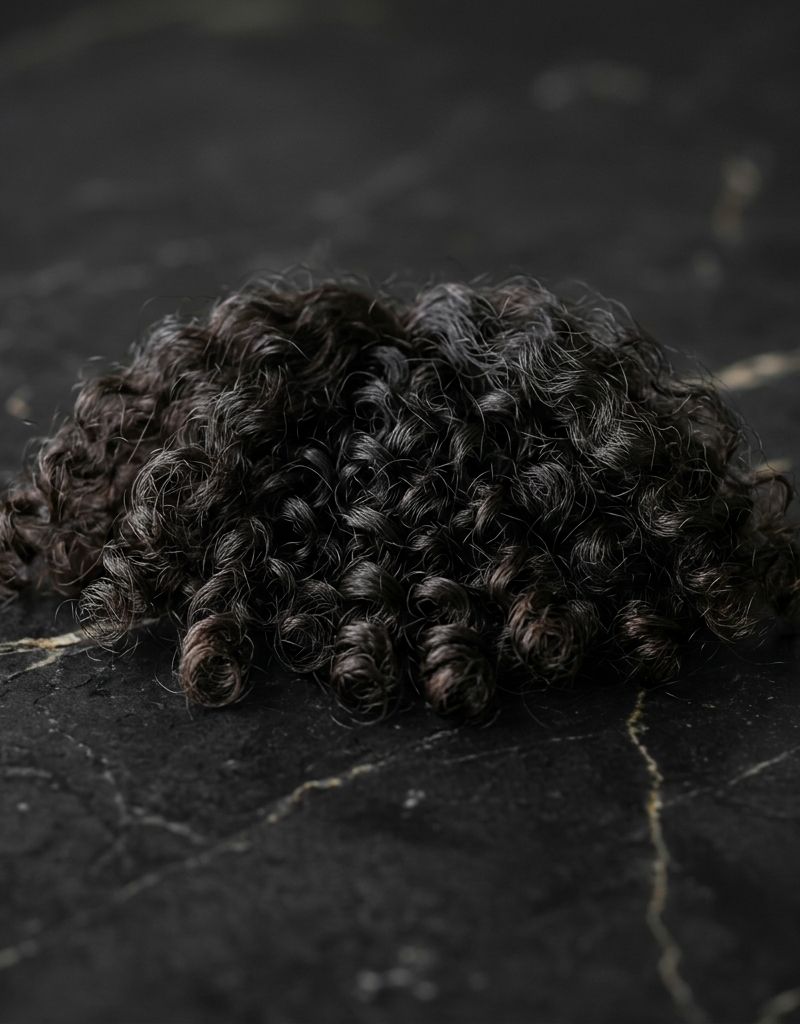
You finish a color on a curly head, the result reads patchy, and the first thing you question is the formula.
That is the logical move. The mirror shows tone that did not land, so you blame the bowl. But on curly hair there is a miss that produces exactly the same picture and gets diagnosed as formula far more often than it should be. The math isn’t the problem.
It is about where the product actually reached.
Why does color come out uneven on curly hair?
Because curl clusters. Curly strands do not hang loose and parallel — they lock into each other and form compact groups, and the strands inside the group sit shielded by the ones on the outside. Work with the section size you would use on straight hair and the product saturates the surface of the cluster while the interior processes less. What you get reads as a tone that fell short, when the formula was right all along.
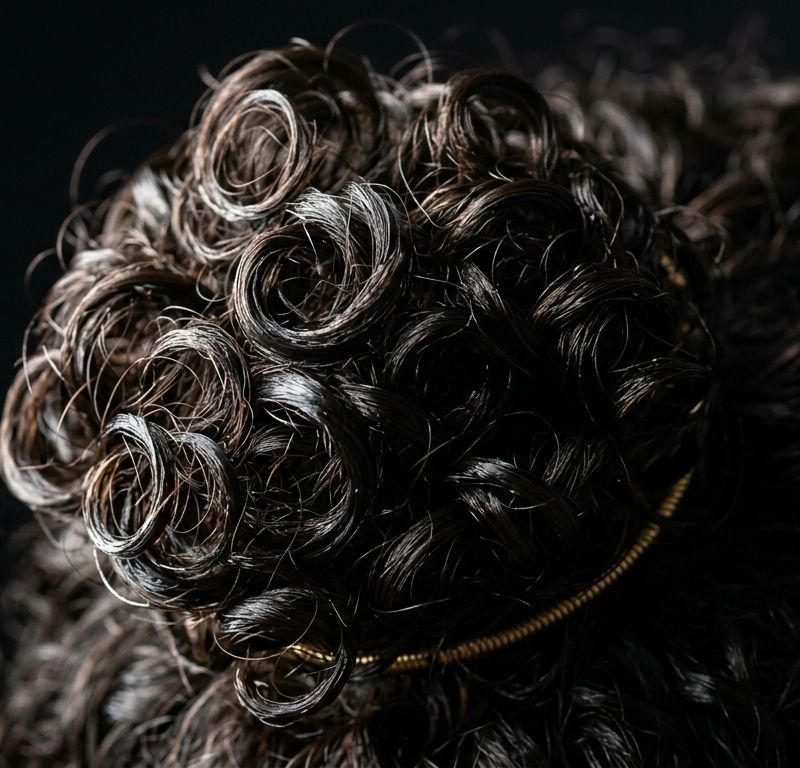
The geometry of the fiber explains it. According to Cloete, Khumalo and Ngoepe’s review of curly hair in Proceedings of the Royal Society A, curly fibers have an elliptical cross-section rather than a round one, and vary widely in their degree of curl. And a systematic review of high curl pattern hair in the Journal of Cosmetic Dermatology notes that the tightly coiled structure of the fiber hinders sebum from travelling down the shaft.
Behind the chair, that means a curly head is not a continuous surface. It is a set of clusters with an outer face and an inner face. And while you work, you only ever see one of them.
This is not the same problem as taking thick sections on straight hair — that also gives you patchy results, but for a different reason: an oversized section means the product never makes even contact with every strand across its thickness, which we covered in common balayage mistakes. Here the cause is different. It is not the thickness of the section: it is that the curl shields some strands with others.
How do I tell a distribution miss from a formulation miss?
Open the section and look at the inner face. It takes a second and it sorts the diagnosis — with one important caveat that comes right after the table.
When you check the result, take a piece from the zone that bothers you, open it with your fingers and compare:
| What you see | Diagnosis | What you fix |
|---|---|---|
| Outer face on tone, interior short | Distribution | Section size and saturation |
| Outer and inner equally short | Formula | Tone, developer or timing |
| Interior on tone, outer face dull | Rinse or post-service friction | Wash protocol and toner |
| Patchy with no inner/outer pattern | Uneven porosity | Porosity assessment up front |
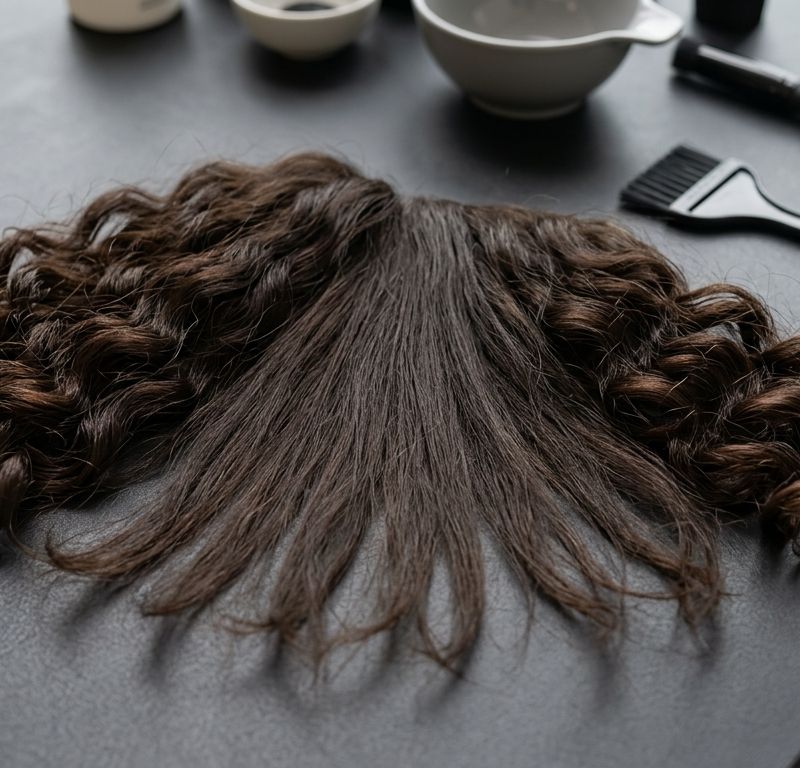
The false positive you have to rule out: hair on the outer canopy carries years of UV and friction, and tends to sit more porous than the hair underneath. That gradient can read exactly the same way — outer face on tone, interior short — without distribution having failed at all. The discriminator costs nothing and you already have it: if you confirmed mid-application that the section was saturated on the inside too, distribution is ruled out and what you are looking at is uneven porosity. Both causes come from the same geometry, so they can coexist; what you cannot do is convict distribution without that check.
The first two are the ones that get confused daily. And the difference matters because they lead to opposite moves: if the miss was distribution and you remix, you push tone or developer onto hair that never needed it, and the next service inherits damage that had no reason to exist.
Pro tip: run this check while the hair is still damp, before drying. Once the curl is dry and formed, the inner face hides again and the diagnosis gets harder.
There is a second tell that never fails: if you had to stretch the product to cover the whole section during application, the section was too big. Correct distribution does not require rationing the mix.
What sets section size on a curly head?
This is where a mental shortcut sneaks in: assuming the curl itself dictates section size. It does not.
Section size is set by density (how many strands per square inch) and strand diameter. What curl does is group those strands, which is why identical density behaves differently depending on the curl pattern.
Put another way: two heads with the same density and the same strand diameter need different distribution if one is straight and the other curly, because on the curly one part of that density is hidden inside the cluster.
In practice that comes down to three calls:
- Take the section down from what you would use on straight hair at that density. On very dense hair, take it down further.
- Apply on both faces of the section, not just the one you can see. The inner face is the one that runs short.
- Check before you fold or move on, not at the end of the service. Correcting there costs seconds; correcting at the shampoo bowl is not correcting.
If you want concrete section thickness ranges by density, we break them down in the sectioning part of the professional coloring techniques guide.
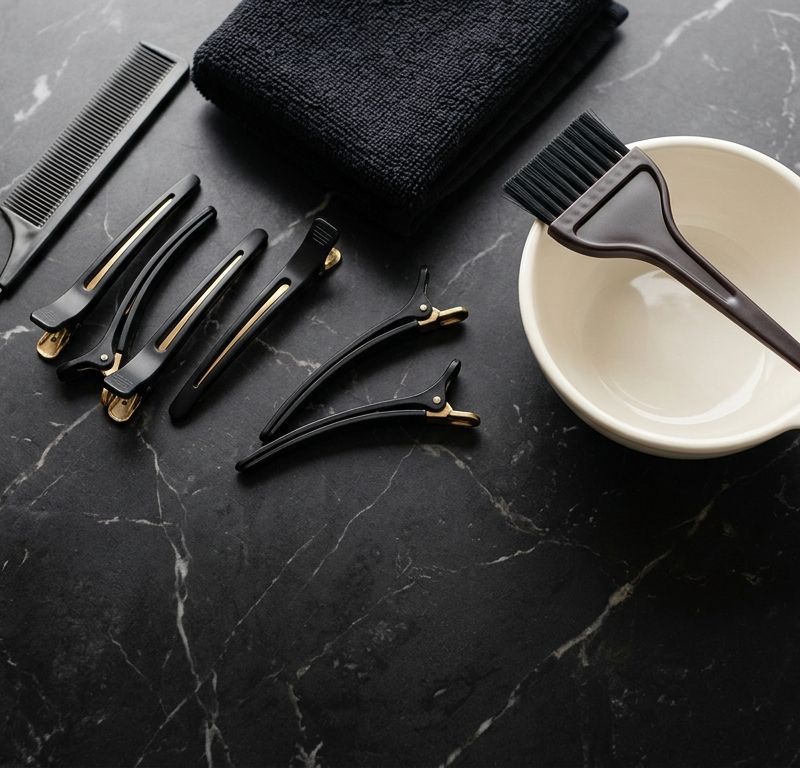
How do you apply color without leaving the interior short?
Order matters as much as size. On a curly head, the application that works treats every section as an object with volume, not as a surface.
Before you mix: section the head into four on damp, detangled hair. Dry, the curl is already clustered and every section you take inherits that grouping. Damp is for parting cleanly and seeing the true regrowth line; whether you apply on damp or dry hair is set by your product’s instructions, not by the curl.
As you apply, section by section:
- Lift the section and go in on the inner face first, the one facing the scalp. It is the one that gets forgotten and the one that decides the result.
- Come back over the outer face and saturate until the strand looks covered, reloading the brush as many times as it takes. On dense curl you reload a lot, and that is normal: textured hair drinks product. Rationing the mix here manufactures the very problem you are trying to avoid. The tell for an oversized section is having to stretch the product, not having to reload.
- Work the product through with your fingers along the section before you move on. That is not a cosmetic gesture: it moves what sat on the surface into the interior of the cluster.
- Open and check one section per zone as you go. Four checks across the service save you the wrong diagnosis at the end.
During processing, always check the same reference section per zone. Switching pieces between checks adds noise: you cannot tell whether you are seeing the color develop or a zone that got treated differently.
One note on timing: applying on two faces takes longer, and processing time counts from when you finish, not when you start. On very dense heads that gap between first and last section is real, and worth holding in mind when you book the slot.
Common mistakes on curly hair color
- Formulating on a distribution diagnosis: pushing tone or developer volume to compensate a zone that never received product. It raises damage, not evenness. The full catalog of calculation misses lives in common color formulation mistakes.
- Applying only on the visible face: the curly section has two faces and the inner one decides the result.
- Judging color dry and unopened: formed curl covers exactly the zone you need to see.
- Blaming the manufacturer: it is the natural conclusion when the formula repeats and fails again. It repeats because the gesture repeats.
- Skipping the strand test: it tells you about the formula, not about distribution. If you also want to read distribution, leave the test piece inside its own cluster at the nape and open it there.
One question comes before any of this: has the hair been chemically straightened? Relaxer, texturiser and keratin services all leave the cortex in a different state than virgin curl, and an oxidative service on top of that is where breakage happens — not at the point of application, but days later. If the history includes straightening, the elasticity assessment and the strand test stop being formalities and become the decision itself. Check your manufacturer’s guidance on interval and developer limits for previously straightened hair before you formulate.
Permanent color and lightening also require an allergy alert test 48 hours before every color application, plus a strand test and an elasticity assessment before you start. Curl pattern does not change any of the three.
Frequently asked questions
Do I need more product on a curly head?
Often yes, but quantity is the consequence, not the cause. If you section appropriately and apply on both faces of the section, the volume you need rises naturally. Mixing more without changing distribution fixes nothing: it ends up on the surface of the cluster exactly as before.
Is curly hair always more porous?
Not necessarily. Virgin curly hair can be low or medium porosity. What happens is that curvature lifts the cuticle unevenly, which can read as high porosity by touch. Always assess with the proper test before assuming porosity.
Can I use the same formula as on equivalent straight hair?
Yes, if base diagnosis, history and porosity are equivalent. Formula answers to the chemistry of the hair, not to its shape. What changes on curl is distribution: same math, different execution.
How do I know whether it was me or the product?
Open the section. If the outer face came out on tone and the interior did not, the product did its job where it landed. If both came out equally short and every other variable was controlled, then yes — revisit formula, developer or timing.
Key takeaways
- Curl groups the strands: the inner ones sit shielded and process less than the outer ones.
- A distribution miss reads exactly like a formulation miss in the mirror, but it is corrected the opposite way.
- The check is opening the section and looking at the inner face, damp and during the service.
- Section size is set by density and strand diameter; what curl does is group.
- Remixing over a distribution miss adds damage without adding evenness.
Calculate professional formulas with AI
Distribution is on you — no tool fixes it. What a tool can do is take the formula off your plate, so what is left of your attention goes to the section in your hands. Blendsor calculates from base level, porosity and each client’s chemical history.
How many times have you remixed something that was really distribution?
Related articles

Practice with our colorimetry tools
Calculators, neutralization wheel, AI consultation...
The Blendsor newsletter
Color techniques and trends for professionals. No spam.
A client in the chair right now?
The Blendsor advisor gives you the precise formula for this technique with your salon's brands — and saves it to your client's card.
Ask about your caseWritten by the Blendsor team
Professional hair colorimetry experts with experience in AI-assisted formulation. We combine color science, salon practice and technology to help colorists formulate with precision.