Hair Color Formula Management: Complete Professional Method
How to record hair color formulas like a pro: what to log per service, the real cost of skipping records, paper vs digital, and salon workflow.
Blendsor
Blendsor Team

How much does a color redo cost your salon per month?
Not just in product. In blocked appointment time, in the uncomfortable conversation with the person sitting in your chair, in the trust that erodes even when the final result ends up acceptable. An avoidable redo is not an accident — it is a signal that your record-keeping system failed.
Hair color formula management is not paperwork. It is the methodology that turns every service into reusable data, reduces redos, and makes salon profitability scale with your clientele rather than against it.
Quick summary: Professional formula management means recording seven data points per service — diagnosed base level, porosity, exact dye code, developer and volume, gram weights, actual processing time, and actual result. Without that record, the cost of redos and search time far outweighs any documentation effort. The storage format — paper, spreadsheet or app — is secondary. Consistent recording is what drives outcomes.
Why does formula management break down in real salon practice?
Formula management breaks down for three main reasons: the formula gets recorded but not the actual result, the storage format doesn’t fit the real workflow, and there is no defined protocol for when each data point gets logged. Without all three elements working together, the system exists in theory but gets abandoned the first busy week.
It is not a lack of intention. It is a lack of system.
A colorist with years of experience carries a well-trained mental file on every regular client. You know who needs a level 7 with a golden reflection, who has high porosity at the ends, who reacts to 30 volume developer. That mental knowledge works well with ten or fifteen recurring clients.
At twenty-five or thirty, the cognitive load of color work exceeds what reliable memory can hold. A professional color service simultaneously manages: hair diagnosis, formula calculation, product mixing, processing times by zone, conversation with the client, schedule monitoring, and attention to the rest of the team. That is seven categories of active information running in parallel. When too many variables are active at once, lower-urgency data gets compressed or lost.
The solution is not to have a better memory. It is to stop depending on memory for data that can be recorded.
For an in-depth look at what fields to include on every formula card and why the record is your salon’s most valuable operational asset, read our guide on how to organize hair color formulas in your salon first. This article builds on that foundation and covers the complete methodology: workflow integration, the real cost of not recording, storage comparison, and profitability impact.
What data should you record at every color service?
Every color service requires seven minimum data points: actual diagnosed base level, porosity, exact technical dye code with brand and line, developer and volume, gram weights of the mix, actual processing time, and actual result compared to the expected outcome. Without those seven data points, the formula cannot be reproduced reliably.
There is a significant difference between noting “warm brown with highlights” and recording:
| Field | Example of correct record |
|---|---|
| Diagnosed base level | 5 (light brown), confirmed with shade guide at nape under neutral light |
| Porosity | High on mid-lengths and ends (treated at previous visit) |
| Dye code | 6.35 Wella Koleston Perfect + 7.43 Koleston Perfect |
| Mix proportion | 40 g of 6.35 + 20 g of 7.43 |
| Developer | 60 ml 20 vol Welloxon Perfect |
| Actual processing time | 40 min roots, 25 min mid-lengths (added 5 min) |
| Actual result | Warm copper brown. Slightly darker than expected at root. Next visit: increase 7.43 by 5 g. |
That last line is the one most people skip — and the one that makes the biggest difference at the next appointment.
The actual result is not just “looked good” or “looked off.” It is the gap between what you planned and what happened, plus the specific adjustment needed next time. Without that data, every visit starts from the same unupdated assumption.
To calculate exact gram weights based on hair length and density before logging them, the developer mix calculator is a practical starting point.

The data points that get skipped most often
The chemistry explains it: consistency in formulation is one of the primary factors determining client satisfaction in professional color services. Inconsistency rarely comes from poor technique — it comes from missing precise data between visits.
The three data points that get skipped most often:
Post-processing adjustments. If you applied a toner, cut the processing time because of how the hair reacted, or added a gloss treatment after the color — all of that is part of the final result. Recording only the base formula without the adjustments means recording an incomplete version of the service.
A photo of the result on dry hair. The shade perceived under salon lighting is different from the shade perceived in natural light. A photo with the hair dry under neutral light is the most reliable reference available. It is worth more than ten lines of text description.
The service context. How much regrowth was there, what change was the client asking for, whether they were coming in outside their normal cycle. That context explains why certain decisions were made and is essential for interpreting the history at future appointments.
What is the real cost of not keeping records?
The cost of skipping formula records distributes across four areas: direct redos, accumulated search time, erosion of client trust, and loss of knowledge when team members change. The most visible cost is the redo; the most expensive long-term is eroded trust.
Avoidable redos
A color redo costs between $15 and $40 in product depending on the service. In appointment time, it blocks between 30 minutes and two hours of productive capacity. And in the relationship with the client — even when the final result ends up satisfactory — it introduces friction that should not be there.
Most avoidable redos share the same cause: the formula applied at the previous visit was not documented in enough detail, and the next visit started from an incorrect assumption.
The result does not need to be a disaster for the cost to be real. “It looks a little different from last time” is enough for trust to start eroding.
Accumulated search time
Without a system, looking up a previous formula takes 3 to 7 minutes. With an organized system, 10 to 30 seconds. With 8 appointments per day, that difference amounts to 20 to 50 minutes every day. Per month, that is more than 12 hours of productive capacity either recovered or lost, depending on the system in place.
Knowledge loss when team members change
When someone joins or covers for another team member, the history of each client should not be stored in the memory of whoever left. If it is, that knowledge walks out the door. A new professional who joins a salon with complete records can work with confidence from the first appointment. One who joins a salon without records has to rediscover every client — and that learning curve is paid by whoever is sitting in the chair.
Paper vs. digital: an honest comparison by work volume
There is no universally better format. There is the format you actually use consistently given your real working context. The right choice depends on client volume, team size, and how much mobility the system needs.
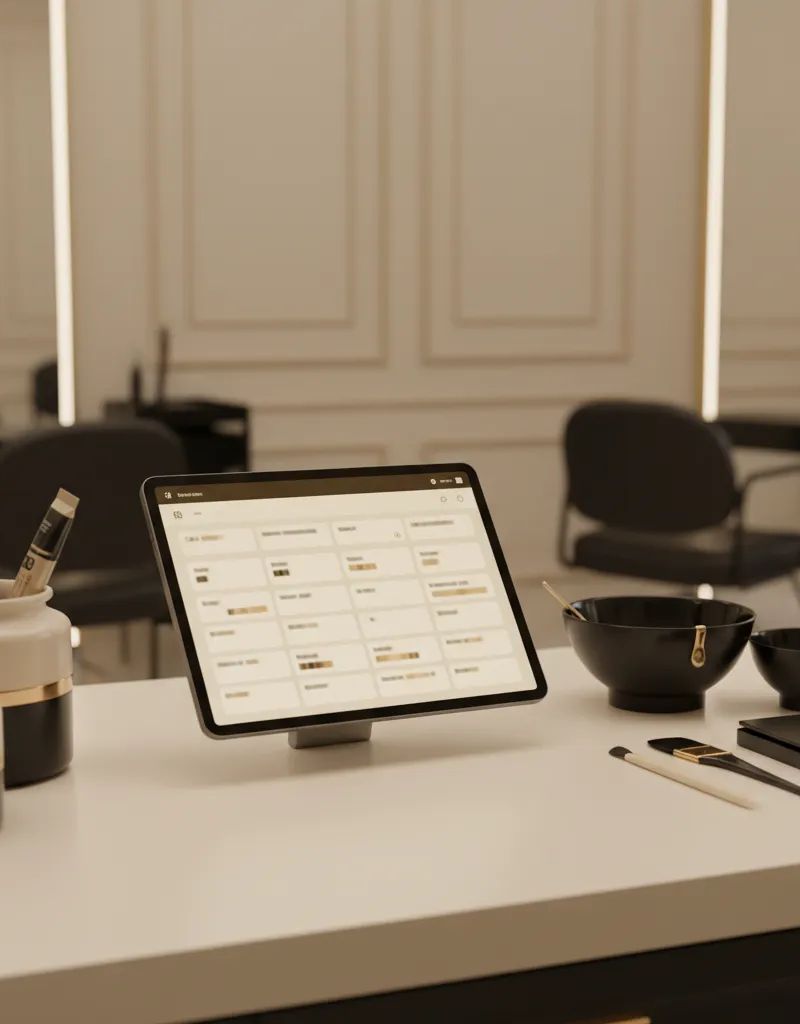
| Format | Lookup speed | Backup | Photos | Team sharing | Best for |
|---|---|---|---|---|---|
| Physical notebook | Slow (flip through pages) | None | No | Not shareable | Under 25 active clients, solo work |
| Spreadsheet | Fast (search by name) | Yes (cloud) | Difficult | Shareable with friction | 25–80 clients, solo or small team |
| Generic notes app | Medium (depends on tagging) | Yes | Yes | Limited | 20–60 clients with irregular workflow |
| Specialized colorist app | Very fast (5–10 seconds) | Yes, automatic | Yes, integrated | Yes, with permissions | 40+ clients or any team of 2 or more |
Paper: real advantages and structural limits
The notebook has advantages worth acknowledging: it is immediate, requires no device or connection, works in any salon context, and has zero learning curve. A well-designed paper card takes ninety seconds to complete.
Its limitations are structural. There is no search: finding the record for someone who comes every three months means flipping through pages or maintaining a perfectly indexed system. There is no backup: a water-damaged, lost, or stolen notebook means years of work gone. And it is not shareable with the team without photocopying or transcribing by hand.
Pro tip: If you use a notebook, organize alphabetically by last name with dividers. A ring binder you can reorganize beats a bound notebook. Take a photo of the full notebook and save it to the cloud every week.
Digital: the only real obstacle is adoption friction
Digital storage solves exactly the paper’s structural limitations: instant search, automatic backup, access from any device, and real-time sharing with the team.
Its only real obstacle is adoption friction: it requires discipline to complete at the moment of service. If the workflow is not designed to integrate the recording step, a digital system ends up just as inconsistent as paper.
A practical rule: if the salon has two or more professionals, or handles more than twenty recurring clients per month, digital stops being a comfort upgrade and becomes an operational necessity.
For anyone making the transition, the most effective approach is not to migrate everything at once. Start this week with your ten most frequent clients in the new system. Clients who come in over the next three months get added naturally. Clients who have not been in for six or more months do not justify retroactive migration effort.
Blendsor manages color formula records with per-client history, name-based search, and integrated level diagnosis — no manual configuration needed.
How do you integrate record-keeping into the real salon workflow?
Formula records fail when they become a task separate from the service rather than part of the protocol for every appointment. Integrating records into the workflow means deciding exactly when each data point gets recorded — before it becomes optional.
The protocol that works in practice has three moments:
Before the service (2–3 minutes). Pull up the record from the previous visit: base level, porosity, actual result, and the adjustment noted last time. If there is a pending adjustment, incorporate it into today’s formula. If there is no record, this is when you run the full diagnosis and log it before starting.
During the service (30 seconds). Note any variation from the plan: extra processing minutes, proportion adjustment made on the spot, unexpected hair behavior. These data points disappear if not recorded in the moment.
After the service (2–3 minutes). Complete the record with the actual result, the photo, and the adjustment for next time. This is the step that gets skipped most often because the salon’s rhythm is already looking toward the next appointment.
When the post-service record becomes part of the closing protocol for every appointment — the same as checkout or booking the next visit — it stops being an extra task and becomes part of the natural flow.
Avoiding the most common errors in this process — such as copying formulas between clients without diagnosing, or recording only the commercial shade name instead of the technical code — is covered in our guide to common color formulation mistakes.
For those working with custom mixes or specific developer ratios, the developer mix calculator helps verify gram weights before logging them on the record card.

How does formula management affect salon profitability?
Consistent formula management directly impacts salon profitability through three mechanisms: it reduces redos, enables informed upsell conversations, and makes the salon transferable. The most underestimated mechanism is the informed upsell — client history reveals patterns that would be invisible without data.
Informed upsell from client history
The formula record is not just technical documentation. It is the foundation of the most profitable conversations in the salon.
If three consecutive visits require a higher developer volume to achieve the same result, the hair is losing responsiveness. That is a conversation about pre-treatment, a technique change, or a complementary product. Without the history, that conversation has no data. With the history, it has context and real urgency.
If porosity has been trending upward over time, pigment behavior is changing. If the percentage of gray hair has increased, the formula needs adjusting. All of those patterns are conversation opportunities that only exist if the data shows them. For a deeper look at how mix ratios interact with these variables, our guide on mixing hair dyes and ratios covers the technical criteria.
Controlled service cost
Knowing the exact gram quantities used at each service makes it possible to calculate the real cost of every appointment. That figure, combined with what is charged, is the basis for per-service profitability management. Without those data points, salon profitability is an estimate. With them, it is a verifiable number.
Salon transferability
A salon with complete and current records has a documented asset. A salon without records has implicit knowledge that leaves with the professionals.
When someone new joins the team, documented knowledge reduces the learning curve. If the salon is sold or takes on partners, the formula database has direct economic value. It is part of the transferable asset.
Frequently asked questions
How long does it take to record a formula properly?
With the protocol integrated into the workflow, two to four minutes per service. That includes completing the record, noting the actual result, and taking the photo. It is a minimal investment compared to the seven to fifteen minutes lost searching for a poorly documented formula or redoing a service that came out different from last time.
Should you record the formula even for a client who comes every three weeks?
Yes, especially in that case. Frequent appointments create the illusion that memory is sufficient. But three months of vacation, a team member change during leave, or a product line update are enough for that memory system to fail at the worst moment. Visit frequency does not substitute for a record.
What happens if you switch color brands and the old codes are no longer valid?
The history does not get erased — it stays as a historical reference, and the new formulation gets added as an updated entry. The older records remain useful because they describe the target result and the hair’s behavior, even if the dye code has changed. That context is what allows you to adapt the new formulation with real criteria, not guesswork.
How do you get a team to record formulas consistently?
Consistent adoption does not come from persuasion — it comes from protocol design. If recording is a separate task that happens “when there’s time,” it never happens. If it is part of the closing protocol for every appointment — the same as charging or booking — it happens by default. Define the exact moment, keep the form as simple as possible, and review compliance during the first two weeks.
Is it legal to store client data in an app?
Yes, as long as you comply with applicable data protection regulations — GDPR in Europe, and relevant state privacy laws in the US. You need client consent to store personal data, you must inform them what data you keep and for what purpose, and you must ensure they can request deletion. Most professional apps include mechanisms to meet these requirements.
Key takeaways
- Record seven minimum data points per service: diagnosed level, porosity, dye code, developer and volume, gram weights, actual processing time, and actual result with the adjustment for next time
- The cost of not recording is cumulative: redos, search time, and trust erosion add up to more than any documentation effort
- The format is secondary: what determines the system is recording consistency, not the tool
- Records work when integrated into the protocol for every appointment, not when they are a separate task
- Client history has direct economic value: informed upsell, controlled service cost, and a transferable salon
How is your current record system working? What is the data point that is hardest to keep up to date?
Blendsor — formula management with per-client history, level diagnosis, and instant search.
Related articles



The Blendsor newsletter
Color techniques and trends for professionals. No spam.
Every client, one tap from their history
Formulas, hair health and evolution saved on their own. You and your team open the card and pick up where you left off.
See how it worksWritten by the Blendsor team
Professional hair colorimetry experts with experience in AI-assisted formulation. We combine color science, salon practice and technology to help colorists formulate with precision.